
A spacecraft trajectory, a changing glacier, or a planet orbiting another star can be difficult to grasp as a table of measurements. NASA’s interactive projects approach the problem differently: they turn scientific information into places people can navigate, manipulate, hear, and explore. Across simulations, maps, games, and sonification tools, audiences are invited to participate in the act of understanding rather than simply observe its results.
Turning scale into experience
NASA’s Eyes experiences translate enormous scales into interactive 3D environments. Eyes on the Solar System lets visitors explore planets, moons, asteroids, comets, and spacecraft while moving through a timeline that spans from 1950 to 2050. Eyes on Asteroids presents more than 30,000 near-Earth asteroids and highlights upcoming close approaches, while Eyes on Exoplanets opens a navigable view of more than 5,500 planetary systems. These tools do not make distant destinations physically reachable, but they make their relationships, motion, and scale easier to investigate.
The same principle applies closer to home. Eyes on Earth allows visitors to follow Earth science missions, examine planetary indicators, and view satellite imagery associated with major weather events. The Climate Time Machine and Global Ice Viewer place environmental change into visual sequences, showing how climate indicators and ice coverage have shifted. Presented this way, a record is no longer only a collection of values; it becomes a pattern that can be followed across geography and time.
More than looking
Some of NASA’s projects expand exploration beyond conventional images. Hearing Hubble uses data sonification, assigning sounds to elements within an image and allowing visitors to create their own interpretation. The Hubble Skymap offers a route through galaxies, stars, and nebulae observed by the telescope. Together, they demonstrate that scientific data can support multiple forms of attention: a person might trace a structure visually, encounter it through sound, or discover it by moving through a map.
Games and stories create another route into the same material. Hubble’s Cosmic Adventure uses questions and choices to guide players toward destinations in the universe. The Lost Universe frames astronomical learning as a tabletop role-playing quest. Resources including NASA Kids’ Club, Climate Kids, and Space Place adapt space and Earth science for younger audiences through activities, videos, and games.
Discovery as an active role
The editorial lesson is not that interaction automatically produces understanding. It is that thoughtful interfaces can give curiosity somewhere to go. Rewinding a trajectory, roaming a telescope map, comparing ice over time, or listening to an image turns an abstract subject into a sequence of deliberate actions. NASA’s collection suggests a useful model for science communication: preserve the underlying mission data, then build an experience that lets people ask their own next question.
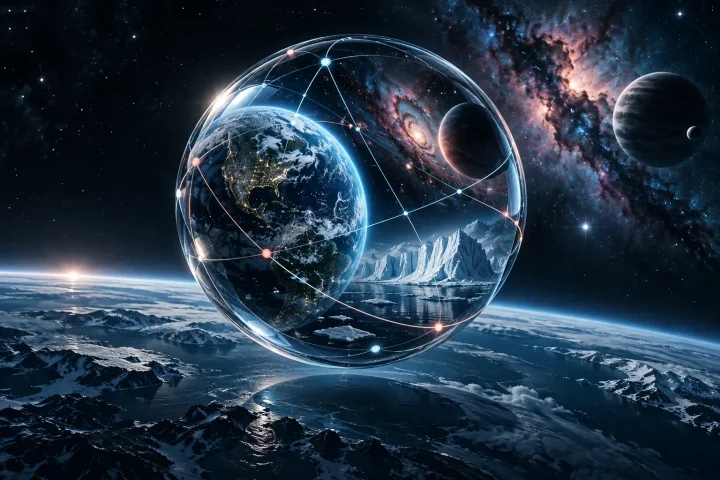
AI-generated editorial illustration; not a documentary photograph.
Source: Games and Interactives
 SIGNAL TITANS
Leave a Reply