
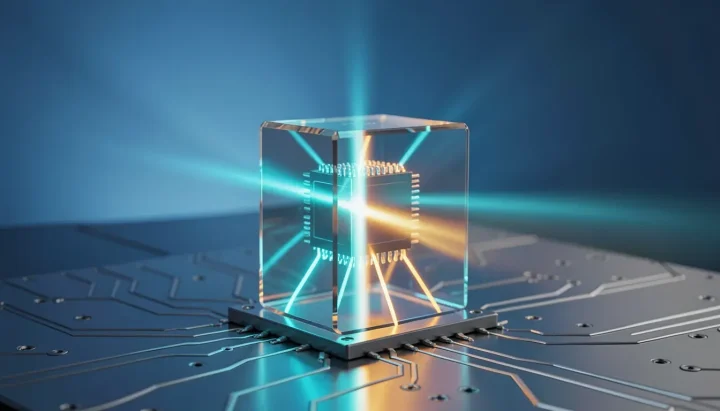
Silicon Valley startup Volantis, supported by OpenAI chief executive Sam Altman, has outlined an ambitious strategy to tackle the growing memory wall in modern artificial intelligence hardware. The company proposes integrating photonic technology directly inside AI accelerators to fundamentally redefine how data moves between computational cores and high-bandwidth memory units.
Replacing Copper Wires With Optical Interconnects
The core architectural innovation targets the physical boundaries inherent in conventional semiconductor packaging. Standard processor designs depend heavily on copper wiring to transport data between memory modules and arithmetic logic units. As computational speeds accelerate, traditional electrical signals encounter physical degradation and latency overhead.
To resolve these physical constraints, Volantis embeds optical silicon components directly onto the accelerator substrate. By routing signals via light channels rather than traditional copper interconnects, the architecture establishes direct optical pathways across chip components to achieve seamless data transmission.
Bypassing the AI Memory Wall
The memory wall has emerged as a critical structural limit in hardware engineering. While modern computational logic has scaled rapidly to process vast matrix operations, data transfer rates across copper interfaces have failed to match that growth trajectory, causing processing cores to frequently stall while waiting for incoming memory payloads.
Shifting from electrical traces to integrated photonic channels allows hardware designers to significantly expand bandwidth capacity. Embedding optical links within the core accelerator package enables faster data throughput, helping system architectures keep pace with demanding workload requirements.
Addressing Power and Speed Limits
Leveraging optical pathways within chip packages yields major improvements in operational thermal dynamics and power consumption. Traditional copper interconnections consume substantial electrical energy and generate significant thermal output when driving high-frequency signals across circuit interfaces.
As giant language models and dense neural networks require continuous data transfers across massive arrays, co-packaged photonics provides a scalable path forward. Utilizing light to bridge processor arrays and memory supplies allows next-generation hardware to scale bandwidth and energy efficiency beyond the inherent limitations of copper wiring.
AI-generated editorial illustration; not a documentary photograph.
Source: Rails originator roasted over Rust boosterism
 SIGNAL TITANS
Leave a Reply