
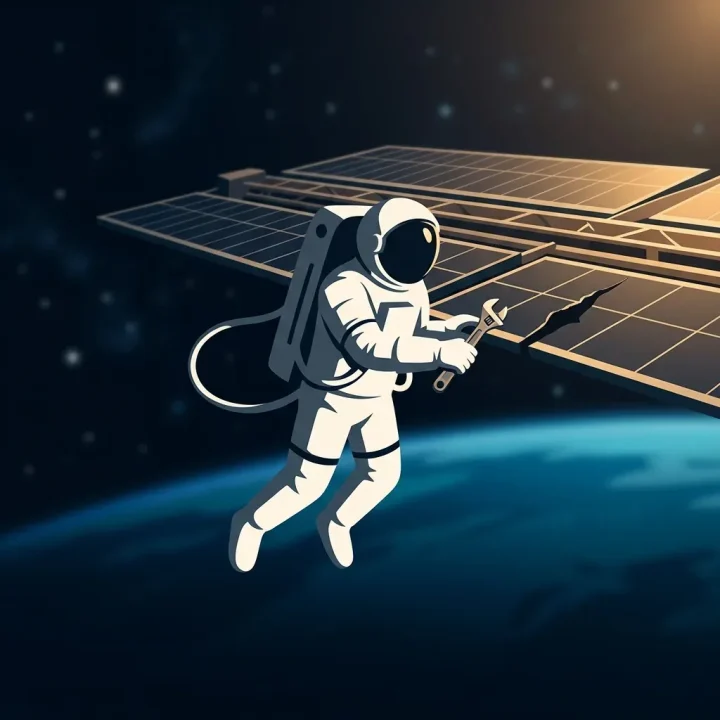
On June 3, 1965, astronaut Edward H. White opened the hatch of his Gemini 4 capsule and stepped into open space. Floating outside for 36 minutes, White became the first American to perform an extravehicular activity (EVA). While his movement appeared effortless, early spacewalks proved far more exhausting than NASA engineers had anticipated. Moving without rigid leverage or established operational techniques turned routine physical tasks into severe physical struggles against pressurized suits in zero gravity.
Learning to Work in Weightlessness
Early Gemini missions demonstrated that floating in orbit differed dramatically from performing useful maintenance work. Spacewalkers repeatedly struggled with suit rigidity and a lack of foot restraints. To overcome these physical constraints, astronaut Edwin "Buzz" Aldrin introduced underwater simulation training during the final Gemini flight. Practicing extravehicular maneuvers in neutral buoyancy pools enabled astronauts to develop controlled movement techniques. According to NASA history accounts, underwater rehearsal transformed spacewalking from an unpredictable flight experiment into a structured engineering discipline, paving the way for lunar missions and orbital space station assembly.
Laying the Modular Foundation of the ISS
During the 23 years between the first spacewalks in 1965 and the start of International Space Station (ISS) assembly, astronauts and cosmonauts completed 171 spacewalks across low Earth orbit, the lunar surface, and deep space. That extensive experience proved essential when station construction began. On December 7, 1998, during mission STS-88, astronauts Jerry L. Ross and James H. Newman performed the first ISS spacewalk to connect critical electrical and data cables between the Zarya and Unity modules. Spacewalk endurance reached a historic milestone on March 10, 2001, when Expedition 2 crewmembers James S. Voss and Susan J. Helms conducted an EVA lasting 8 hours and 56 minutes, which remains the longest spacewalk in history.
Cufflinks and High-Stakes Orbital Repairs
As the space station expanded, orbital maintenance demanded real-time technical problem-solving. In October 2007, during the STS-120 mission, a torn solar panel threatened to stall the deployment of the relocated P6 truss solar array. Astronaut Scott E. Parazynski, positioned at the limit of a combined robotic arm and inspection boom, performed a delicate repair using custom-built wire stabilizers named "cufflinks." Parazynski threaded and secured five cufflinks to reinforce the damaged panel structure. This allowed station controllers inside to complete full solar array extension safely, restoring power collection capabilities to the station.
In-Suit Hazards and Modern Maintenance
Even with decades of operational refinements, extravehicular activities retained serious physical hazards. On July 16, 2013, during US EVA23, astronaut Luca Parmitano faced a life-threatening emergency when a clogged suit filter caused 1 to 1.5 liters of water to leak inside his helmet. The accumulating liquid covered his ears, vision, and nostrils, forcing him to navigate back to the Quest airlock relying primarily on memory and touch before crewmates safely repressurized the airlock. Modern spacewalking also reached significant demographic milestones; on October 18, 2019, astronauts Christina Koch and Jessica Meir conducted the first all-female spacewalk to replace solar array power batteries on the ISS truss.
Standardizing Spacewalk Operations in Orbit
The operational methods honed across 227 ISS-dedicated spacewalks converted dangerous experimental exits into predictable orbital engineering procedures. From Edward White's initial 36-minute float in 1965 to multi-hour structural repairs, neutral buoyancy simulation, custom tooling, and strict safety protocols established extravehicular activity as an essential foundation for human spaceflight.
AI-generated editorial illustration; not a documentary photograph.
Source: Space Station 20th: Spacewalking History
 SIGNAL TITANS
Leave a Reply