
At 11:22 a.m. EST on November 14, 1969, the Saturn V rocket carrying Apollo 12 lifted off into dark, rainy skies above Florida. On board were Commander Charles "Pete" Conrad, Command Module Pilot Richard F. Gordon, and Lunar Module Pilot Alan L. Bean. Thirty-six seconds into the flight, as the vehicle passed through low clouds at an altitude of 6,600 feet, a flash of lightning struck the launch pad. The electrical discharge instantly knocked all three of the spacecraft's primary fuel cells offline.
Lighting Up the Sky
The initial lightning discharge left the crew facing widespread electrical dropouts inside the capsule. Sixteen seconds later, at 52 seconds into the ascent, a second strike hit the vehicle, taking the primary guidance and navigation system offline as well. With telemetry streams scrambled and essential power sources disengaged, the spacecraft continued its upward trajectory while ground controllers scrambled to determine the nature of the malfunction.
SCE to AUX
Inside the Mission Control Center in Houston, electrical systems engineer John W. Aaron monitored the garbled data feeds. Recognizing the specific failure pattern across his telemetry monitors, Aaron deduced that the spacecraft's Signal Conditioning Equipment (SCE)—the system responsible for processing telemetry signals—had suffered an upset. Aaron advised switching the SCE from its Normal setting to Auxiliary power. Alan Bean recalled the position of the switch on his instrument panel and toggled it to Auxiliary. The action immediately restored clear telemetry data to Mission Control, allowing the crew to reset the fuel cells and safely reach orbit.
Targeting the Ocean of Storms
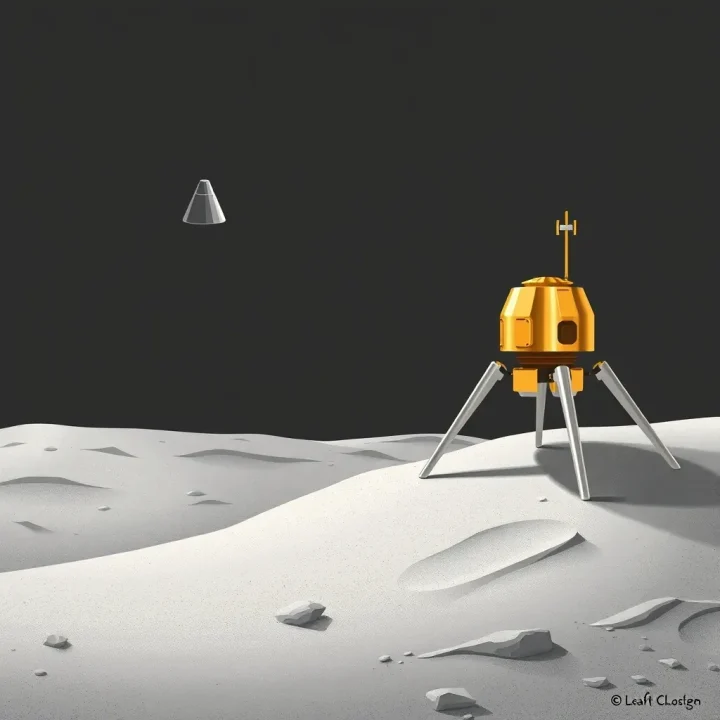
After confirming system integrity and completing the Trans Lunar Injection burn, Apollo 12 traveled toward the Moon. Five days into the mission, Conrad and Bean separated the Lunar Module Intrepid from the Command Module Yankee Clipper, leaving Gordon in lunar orbit. Conrad piloted Intrepid down to the surface, executing a precision touchdown in the Ocean of Storms near Surveyor Crater. Intrepid settled onto the lunar regolith just 538 feet from Surveyor 3, an uncrewed robotic probe that had landed on the Moon in April 1967.
Hardware Recovery in One-Sixth Gravity
Conrad and Bean spent a total of 31 hours and 31 minutes on the lunar surface across two spacewalks. During their surface operations, they deployed the Apollo Lunar Surface Experiment Package to gather long-term scientific data. On their second spacewalk, the pair walked into Surveyor Crater to inspect Surveyor 3. Using specialized cutting tools, they retrieved the craft's television camera, mechanical scoop, and structural hardware. Bringing these components back to Earth allowed engineers to analyze how human-made hardware withstood 31 months of exposure to the vacuum and radiation of the lunar environment.
Pacific Recovery
Following surface operations, Conrad and Bean launched Intrepid's ascent stage to rendezvous with Gordon aboard Yankee Clipper. After completing lunar orbit photography, Apollo 12 began its return journey to Earth. Yankee Clipper splashed down in the Pacific Ocean after a total mission duration of 244 hours and 36 minutes, coming to rest less than four miles from the recovery ship U.S.S. Hornet. Apollo 12 demonstrated that pinpoint lunar navigation was achievable while proving that rapid technical troubleshooting on the ground could salvage a compromised deep-space trajectory.
AI-generated editorial illustration; not a documentary photograph.
Source: 55 Years Ago: Apollo 12 Makes a Pinpoint Landing on the Moon
 SIGNAL TITANS
Leave a Reply