
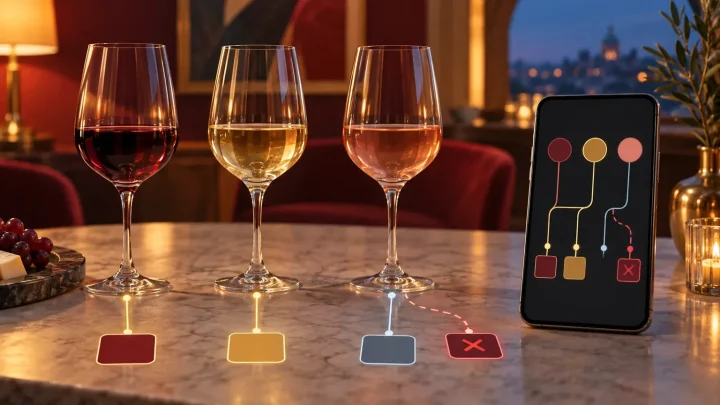
AI-generated editorial illustration; not a documentary photograph.
An AI agent designed to identify wines from written tasting notes correctly recognized two of three samples during a demonstration at Dreamforce 2026, according to a TechRadar report published on September 20, 2026. The result offers a limited example of how an agent can interpret human descriptions of appearance, aroma and flavor, while also showing how a small observation can send it toward the wrong answer.
Descriptions In, Wine Guess Out
Participants accessed the agent, called tAIster, by scanning a QR code with a smartphone. For each mystery wine, it asked them to describe visual characteristics and how the liquid behaved in the glass before moving to aroma and taste. The agent then used those subjective inputs to propose an identification.
TechRadar reported that tAIster had been trained or otherwise educated on information covering roughly 400,000 wines, including attributes related to taste, texture and aroma. The source did not provide technical details about the underlying model, training process or data quality.
One Detail Derailed the Answer
In the reporter's three-sample session, tAIster identified the first two wines correctly. It missed the third, interpreting a mention of small bubbles as evidence for Veuve Clicquot champagne when the sample was Chardonnay. That error suggests the system may give disproportionate weight to an individual clue when working from an inexperienced taster's wording.
A Demonstration, Not a Product Test
The session was presented as a proof of concept rather than an available commercial service. Its reported performance came from one participant and only three samples, so it does not establish a general accuracy rate or show how the agent would perform across different users, wine styles or descriptions.
The exercise also depended entirely on observations supplied by a person rather than allowing the software to sense the wine directly. In this setup, the agent's output reflects both its own interpretation and the specificity and accuracy of the user's tasting notes.
 SIGNAL TITANS
Leave a Reply