
South Africa’s financial technology landscape is undergoing a fierce transformation as digital banks, telecommunications operators, and cross-border remittance firms converge on a single goal: capturing everyday consumer transactions. While companies vie to become indispensable to how users receive, hold, and spend money, data from different industry reports highlights both the massive economic scale of the market and the strategic hurdles ahead. According to TechCabal, card payments in the country reached R2.7 trillion ($149.4 billion) in 2024, a figure corroborated by GlobalData’s payment analytics, which further projects the card market to expand significantly in the coming years.
Scaling Through Infrastructure Partnerships
The strategic shift toward platform ownership is reshaping how newer fintech entrants approach scale. Bank Zero, an app-only lender, reached its first break-even month in August 2026 after five years of operation. Beyond its direct user base, the digital bank is expanding its reach through an alliance banking model that provides underlying infrastructure for third-party partners like retailers and digital platforms. This infrastructure-first strategy mirrors broader industry trends noted by GlobalData, which points to digital contenders like TymeBank and Discovery Bank intensifying competition in the debit card space—a segment that accounted for 74% of South Africa's total card payment value in 2024. Through its partnership with remittance provider Mukuru, Bank Zero absorbs an additional 500,000 accounts onto its rails, though industry analysts observe that overlapping customer bases can muddy exact reach metrics.
Telecoms and Remittance Convergence
Mobile operators and specialized remittance services are aggressively leveraging their existing distribution networks to capture digital financial habits. MTN MoMo is attempting to convert a portion of its telecom subscribers into active financial ecosystem users, recording more than 70 million monthly active users across 14 markets by September 2026. However, bridging the gap between mere telecom distribution and active financial engagement remains challenging, particularly in South Africa where formal banking services compete with entrenched payment habits. Simultaneously, Mukuru is expanding its business model beyond cross-border money transfers into a full neobank strategy, allowing users to hold funds and make payments directly on platform infrastructure supplied by Bank Zero.
Market Projections and Payment Barriers
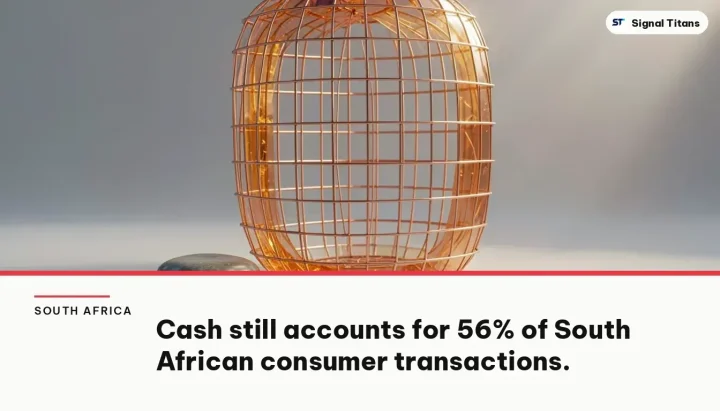
Macroeconomic forecasts underline the growth potential of the region's digital transition. GlobalData projects South Africa's card payments market to reach ZAR2.9 trillion ($158.8 billion) in 2025, climbing further to ZAR3.8 trillion ($206.2 billion) by 2029 at a compound annual growth rate of 6.7%. Contactless payments are accelerating this shift, with nearly 68% of survey respondents reporting access to contactless cards. Despite this momentum, cash remains a dominant force, accounting for 56% of consumer transactions by volume according to a South African Reserve Bank study cited by TechCabal. Academic research by Rushana Pillay indicates that high transaction costs, fragmented industry collaboration, and limited payment interoperability continue to hinder faster digital adoption, forcing fintechs to prove their everyday utility against cash.
The Strategic Battle for Habitual Financial Engagement
The convergence of banks, telecoms, and remittance providers into a unified fintech arena highlights a fundamental strategic truth: simply opening accounts or offering cheap transfers is no longer enough to guarantee long-term survival. As GlobalData and TechCabal illustrate, the real prize lies in securing an enduring place in consumers' daily financial routines. While card values climb and contactless adoption surges, fintech operators face the delicate task of converting one-off transactions into recurring, profitable revenue streams without alienating users through high fees. The tension between owning the underlying infrastructure and controlling the customer-facing brand adds another layer of complexity. Digital banks like Bank Zero provide the rails, but partners often dictate the user experience, raising questions about ultimate brand loyalty. Meanwhile, mobile operators must overcome the behavioral inertia keeping cash alive for over half of all consumer transactions by volume. Ultimately, the fintechs that succeed in South Africa will be those that solve structural friction—such as interoperability and transaction costs—thereby transforming basic distribution networks into indispensable everyday platforms that consumers use without hesitation.
Cover: AI-generated illustration with headline text; not a documentary photograph.
Source: The fierce fintech race for financial loyalty in South Africa goes beyond payments · South Africa card payments to exceed $158 billion in 2025 amid digital surge and inclusion push, forecasts GlobalData – GlobalData
 SIGNAL TITANS
Leave a Reply