
Developers facing notification fatigue can now offload inbox management to a local automated assistant named Snooze Desk, submitted as part of the Hacktoberfest 2026 Open-Source AI Challenge. Conceived to handle the morning deluge of pull requests, dependency bumps, and issues, the project leverages a combination of durable workflow orchestration and local large language models to process notifications entirely on a user's machine overnight.
Architecture and Stack Design
Under the hood, the system relies on a Next.js App Router dashboard paired with the Temporal TypeScript SDK to manage long-running tasks, while Octokit handles GitHub communication. According to project documentation, the core night-time routine runs as a durable Temporal workflow that automates fetching notifications, running local AI classifications, and scheduling reminders without breaking if a service temporarily drops out. When users choose to snooze a notification, the workflow initiates a persistent timer rather than relying on an open browser tab, allowing the item to resurface precisely when scheduled.
Local Model Benchmarking and Performance
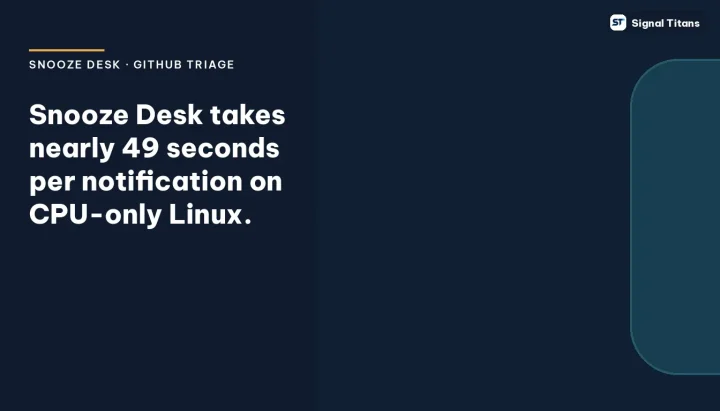
AI inference is executed locally through Ollama, allowing developers to keep sensitive repository contents private without incurring API costs. Developer testing logs from October 2026 on a CPU-only Linux environment reveal important performance trade-offs between different model variants. Initially, smaller models like gemma3:1b processed notifications quickly in under three seconds but struggled with accuracy, labeling nearly every input as urgent. Upgrading to Google's open-weight gemma4:e4b model alongside a refined v2 prompt yielded perfect classification scores during test runs, though mean processing times on CPU reached approximately 49 seconds per notification. To balance speed and reasoning depth, the project splits duties by utilizing gemma4:e4b for strict categorization and gemma3:1b for generating concise morning digests.
Fault Tolerance and Sentry Tracing
To maintain reliability, every model call and activity is instrumented using Sentry AI monitoring, tracking token counts, latency, and prompt versions via dedicated spans. During stress testing where Ollama was intentionally terminated mid-execution, Sentry captured socket errors while Temporal successfully paused, retried, and resumed the workflow once the local inference server came back online. This integration prevents silent failures where dropped connections might otherwise produce misleadingly empty notification summaries.
Balancing Automation, Cost, and Privacy in Developer Tooling
The emergence of tools like Snooze Desk highlights a broader shift toward local-first, agentic developer workflows that prioritize privacy and cost efficiency over cloud-dependent APIs. Managing GitHub notifications often exposes sensitive internal repository details, security advisories, and proprietary code comments that engineering teams may hesitate to transmit to third-party servers. By running open-weight models locally via Ollama, developers retain total control over their data footprint while eliminating recurring subscription fees or per-token API billing. Furthermore, combining local LLMs with robust orchestration frameworks like Temporal addresses the inherent flakiness of running machine learning models on consumer hardware. While CPU-based inference introduces notable latency—averaging nearly a minute per notification in some configurations—running these tasks overnight transforms a performance bottleneck into a non-issue. As open-weight models continue to improve in reasoning and structured output generation, leveraging durable background workflows to handle asynchronous communication chores offers a compelling blueprint for reducing daily cognitive load without compromising security or incurring financial overhead.
Editorial graphic and headline text by Signal Titans.
Source: Snooze Desk: a local Gemma reads my GitHub notifications while I sleep · GitHub – RockingThor/snooze-desk: Lazy developer's overnight desk: local Gemma, Temporal and Sentry triage your GitHub notifications while you sleep. DEV Hacktoberfest 2026 entry. · GitHub
 SIGNAL TITANS
Leave a Reply