
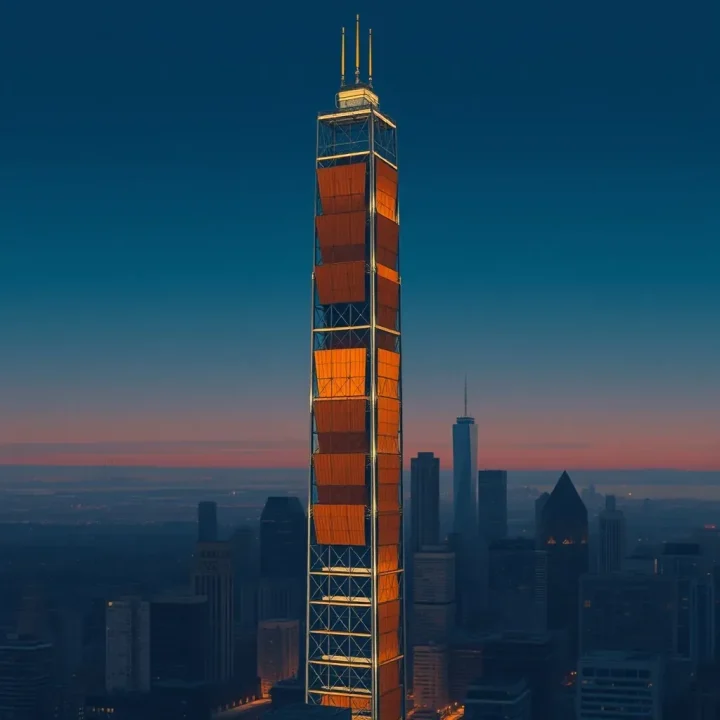
Revitalization Unlimited has proposed a 20-story vertical data center in central Kansas City to bring high-density computing infrastructure directly into urban centers. Designed by Skidmore, Owings & Merrill, the proposed tower occupies a site of just 0.23 acres. This footprint contrasts with conventional suburban campuses, which average 224 acres per land transaction according to research from real estate firm Cushman & Wakefield.
Eighteen Floors of Power and Cooling
Despite spanning 20 stories and 141,000 gross square feet, only two levels inside the building will house computing servers. The remaining 18 floors, covering approximately 109,000 square feet, are reserved for mechanical power and cooling infrastructure. Overall, the facility is designed to deliver 24 megawatts of IT capacity using 30 megawatts of Bloom fuel cells fueled by natural gas as its primary power source, while targeting a power usage effectiveness rating of 1.25.
Premium Costs for Urban Latency
The project carries a total estimated development cost of $183 million, or roughly $1,300 per square foot. Hard construction costs make up $167 million of that total, with mechanical, electrical, plumbing, and fire protection systems accounting for $107 million. Founder and CEO Steve Austin stated that the company is paying a construction premium to demonstrate that urban locations suit latency-sensitive tasks. Shorter physical distances help minimize delays for real-time applications such as AI inference, financial trading, content delivery, and telecommunications, whereas large-scale AI training operations remain better matched for expansive suburban campuses.
Engineering and Operational Trade-Offs
Constructing a vertical facility introduces engineering constraints rarely seen in horizontal data centers. Stacking systems heightens complexities related to heavy equipment handling, elevator payload capacity, and crane operations, raising initial build expenses and complicating long-term maintenance. Onsite natural gas fuel generation also retains operational expenses and emissions, while evaporative cooling equipment means the building will still consume water rather than relying on a water-free closed loop. Approval for the project remains pending, with a development ordinance scheduled for consideration through October 13, 2026.
AI-generated editorial illustration; not a documentary photograph.
 SIGNAL TITANS
Leave a Reply