
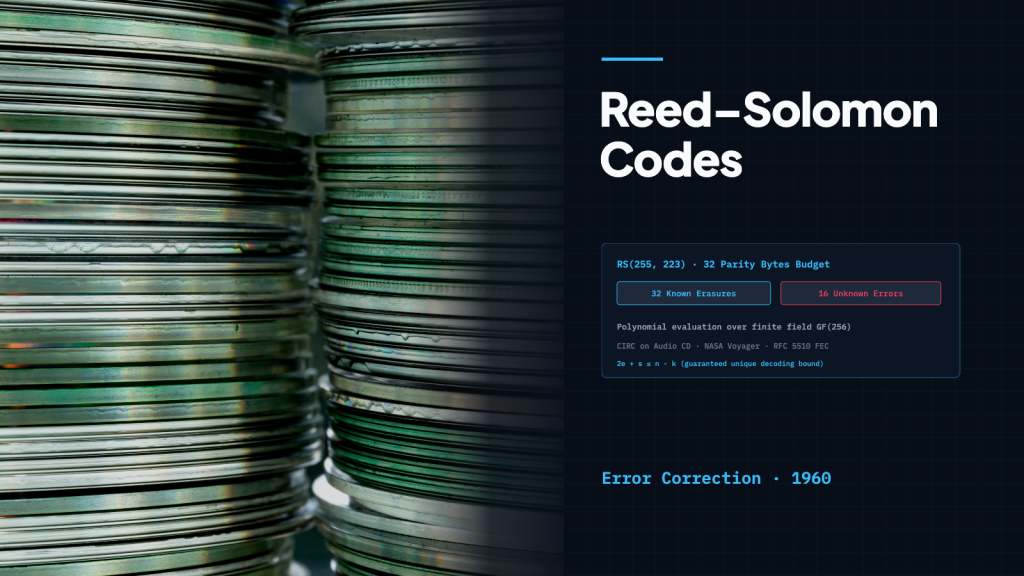
In a Reed–Solomon code, thirty-two extra bytes can recover 32 missing bytes at known locations—or correct just 16 corrupted bytes whose locations are unknown. That tradeoff follows from the error-correcting codes Irving S. Reed and Gustave Solomon introduced in their 1960 paper, “Polynomial Codes over Certain Finite Fields.” Their approach represented a message as a polynomial and transmitted extra values calculated from it, giving the receiver enough information to reconstruct damaged data within a precise limit.
Reed and Solomon proposed encoding blocks of symbols as polynomial evaluations over a finite field. Their paper noted that grouping consecutive bits into symbols could make the code particularly useful when errors occurred in bursts.
Encoding as Polynomial Evaluation
The core mechanism of a Reed–Solomon code relies on basic algebra. Two evaluations at distinct input values uniquely determine a polynomial of degree at most one. Three evaluations at distinct input values uniquely determine a polynomial of degree at most two. In general, k evaluations at distinct input values uniquely determine a polynomial known to have degree less than k.
To encode data using this principle, a sender divides a message into a block of k symbols, such as eight-bit bytes. These k values serve as the coefficients of a polynomial f(x) of degree at most k − 1. Instead of transmitting only the raw coefficients, the encoder evaluates this polynomial at n distinct positions, where n is strictly larger than k. The arithmetic uses a finite field, also called a Galois field: a fixed set of values with rules for addition, subtraction, multiplication and division by nonzero values. A field with 256 values, written GF(256), represents byte-sized symbols. Addition uses the bitwise exclusive-or operation (XOR); multiplication uses polynomial arithmetic that keeps the result within the same field.
Because the original polynomial has degree less than k, any recipient who collects at least k correct evaluations can set up a system of linear equations and solve for the original coefficients. Polynomial interpolation, such as Lagrange interpolation, guarantees that the original message reemerges perfectly from any qualifying subset of surviving evaluation points.
The Redundancy Budget: Erasures Versus Unknown Errors
The practical strength of Reed–Solomon codes lies in how they manage their redundancy budget. The difference between the total number of transmitted symbols n and the original message symbols k represents the parity or repair capacity, n − k. How far this capacity stretches depends directly on whether the receiver knows where the damage occurred.
In digital systems, engineers classify damage into two distinct categories: erasures and unknown errors. An erasure occurs when the system knows the exact position of a missing symbol. In packet networking, for example, dropped packets are easily identified by sequential packet headers; in flash storage or magnetic media, physical defect markers can signal unreadable sectors. When symbol locations are known, the decoder only has to calculate the missing values. Under pure erasure conditions, each redundant symbol can replace one lost symbol. A block with n − k parity symbols can recover from up to n − k erasures.
An unknown error is far more expensive. When symbols arrive corrupted but their locations are unknown, the decoder faces two separate tasks: it must determine which symbols are wrong, and then calculate what their correct values should be. Because locating the error requires additional mathematical constraints, correcting an unknown error consumes two parity symbols of redundancy. A code with n − k parity symbols guarantees unique recovery from any pattern of up to floor((n − k) / 2) unknown symbol errors. With both errors and erasures, the guarantee requires twice the number of unknown errors plus the number of erasures to be at most n − k.
A standard example is the widely used RS(255, 223) code operating on eight-bit bytes. In each 255-byte codeword, 223 bytes contain original data and 32 bytes contain parity checks. Those 32 redundant bytes can reconstruct up to 32 known erased bytes, or locate and correct up to 16 corrupted bytes appearing anywhere across the block. In a systematic RS(255, 223) encoding, the original 223 data bytes appear unchanged alongside 32 parity bytes. A common construction appends parity bytes computed through polynomial division; other systematic constructions use a generator matrix.
From Deep Space to Compact Discs
The original decoding procedure examined subsets of received evaluations, making it computationally expensive for long blocks. Later algorithms avoided this exhaustive approach: Berlekamp–Massey decoding emerged in the late 1960s, and Berlekamp and Lloyd Welch developed another efficient method in the 1980s.
Once efficient decoding became practical, Reed–Solomon codes became essential infrastructure across digital storage and telecommunications. In consumer electronics, optical Compact Discs (CDs) adopted Cross-Interleaved Reed–Solomon Coding to protect digital audio. Scratches or dust can interfere with reading consecutive recorded symbols. Cross-Interleaved Reed–Solomon Coding (CIRC) uses eight-bit symbols and interleaving across successive coding blocks to spread burst damage among codewords. Within its correction capacity, the decoder recovers the original audio; unresolved errors may instead be concealed by estimating missing samples.
In aerospace, the United States National Aeronautics and Space Administration (NASA) deployed Reed–Solomon coding on the Voyager planetary exploration missions. For Voyager 2’s Uranus and Neptune encounters, Reed–Solomon coding helped protect telemetry against transmission errors over the greater communication distances, working with convolutional coding to reduce the error rate in the received information.
The Limits of Recovery
Despite their power, Reed–Solomon codes have strict mathematical limits. Without additional information, more than n − k erasures leave too few evaluations to determine the message uniquely. Beyond the guaranteed number of correctable errors, a decoder designed to return one message within that limit may report failure or return an incorrect block. Some error patterns can still be recovered; another approach, called list decoding, can return several candidate messages beyond that limit.
Internet technical documents in the Request for Comments (RFC) series, including RFC 3453 and RFC 5510, describe how forward error correction supports reliable multicast: sending data to multiple receivers. Repair transmissions can help multiple receivers with different loss patterns. For each source block, recovery requires any k distinct, correctly received encoding symbols with their positions known; packets may carry one or more symbols.
The practical question is whether a receiver knows which symbols are missing or must discover which ones are wrong. In the 255-byte example, the same 32 extra bytes buy recovery of 32 known erasures or correction of 16 unknown errors. Knowing where the damage occurred doubles the number of affected bytes that the code can guarantee to recover.
Related stories
Sources
- RFC 5510: Reed-Solomon Forward Error Correction (FEC) Schemes — IETF
- Finite Field Arithmetic and Reed-Solomon Coding — Russ Cox
- RFC 3453: The Use of Forward Error Correction (FEC) in Reliable Multicast — IETF
- An Introduction to Reed-Solomon Codes: Principles, Architecture and Implementation — Martyn Riley and Iain Richardson
- Reed-Solomon Code — Eric W. Weisstein, Wolfram MathWorld
- Featured image: Dietmar Rabich; Wikimedia Commons; CC BY-SA 4.0 (adapted from the original)
 SIGNAL TITANS

Leave a Reply