
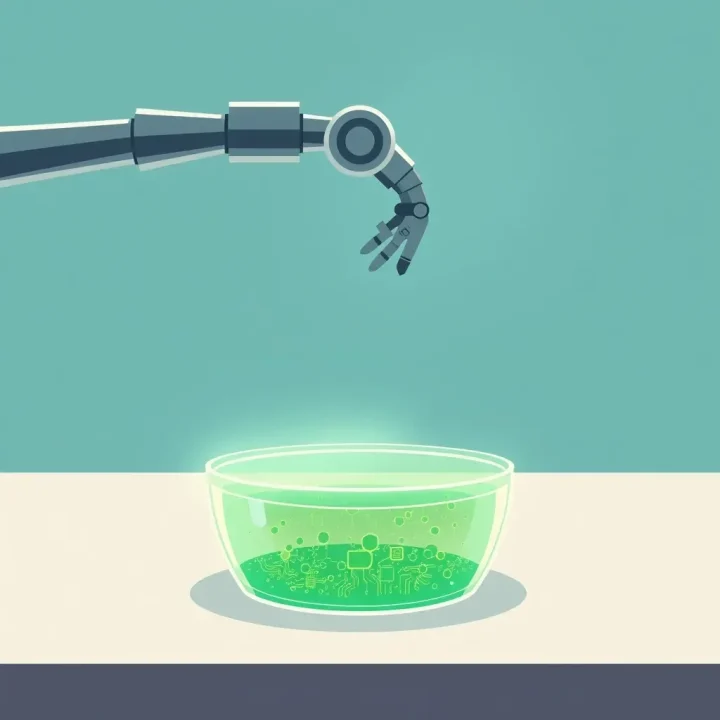
In 2014, Silicon Valley accelerator Y Combinator published a call for applications on its blog, explicitly seeking founders working in synthetic biology. The post compared the emerging field of genetic programming to microcomputers in the 1970s. Five researchers—Jason, Barry, Reshma, Austin, and Tom—read the call. They had spent years developing technology funded by several million dollars in US government scientific grants. Taking a chance on an accelerator known primarily for software, they applied and were selected for Y Combinator’s Summer 2014 (S14) batch, becoming its very first biotech startup.
Licensing the Code of Life
Previous synthetic biology ventures often struggled under the financial weight of building expensive, capital-intensive fermentation facilities. To avoid this constraint, the Ginkgo Bioworks team devised a business model centered on organism design rather than physical manufacturing. Instead of producing industrial chemicals directly, Ginkgo planned to engineer custom biological strains and license them to corporate customers. According to Y Combinator's account, this structural choice allowed the startup to operate with positive gross margins from its earliest days.
During the three months of the Y Combinator program, the founders set out to prove that industrial clients would pay for engineered cells. By the time the batch ended, Ginkgo had validated its licensing hypothesis by securing $1.2 million in customer milestone contracts.
Automation and the Demo Day Pitch
To make biological design repeatable, Ginkgo introduced software controls and laboratory robotics to automate routine tasks. Within two years, this reliance on robotic engineering reduced their cost of genetic engineering by a factor of five, establishing what the founders described as an early parallel to Moore’s law for biology.
When Demo Day arrived, founder Reshma Shetty and the team took the stage wearing distinctive Jurassic Park t-shirts. They pitched Ginkgo as a modern programming stack for cellular biology, contrasting their automated workflow with twenty years of slow, manual organism construction. Supported by their initial contract revenue and documented cost reductions, Ginkgo closed its first institutional financing round shortly after the presentation.
From Boston Foundry to Public Listing
Following their Y Combinator graduation, the founders built a major automated organism engineering foundry in Boston to scale strain design. The infrastructure became a core asset for the broader ecosystem; in 2019, Y Combinator partnered with Ginkgo to give new synthetic biology startups direct access to the Boston foundry. When the COVID-19 pandemic struck in March 2020, Ginkgo pivoted part of its automated foundry capacity into a high-throughput diagnostic lab, rapidly becoming one of the largest automated COVID-19 testing facilities in the United States.
On September 17, 2021, Ginkgo Bioworks completed its public listing on the stock exchange. The transition from government-funded research to a publicly traded enterprise demonstrated that software-style automation and platform licensing could successfully translate complex biological engineering into public market scale.
AI-generated editorial illustration; not a documentary photograph.
Source: Ginkgo Bioworks (S14) is going public today
 SIGNAL TITANS
Leave a Reply