
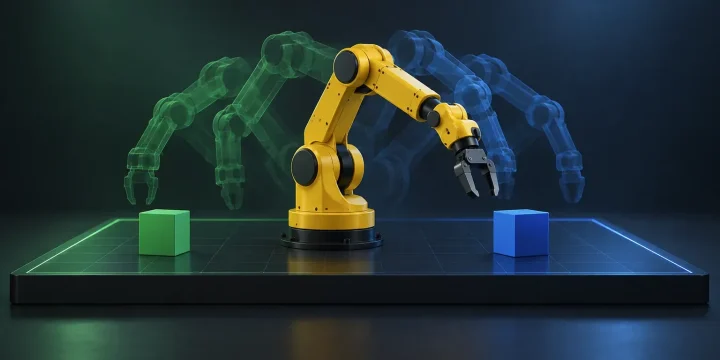
AI-generated editorial illustration; not a documentary photograph.
NVIDIA has published a technical walkthrough for moving a compatible MuJoCo robotics scene to NVIDIA Warp and MuJoCo Warp (MJWarp), with a path from one validated simulation world to as many as 2,048 parallel GPU environments. The article focuses on simulation preparation, migration and measurement rather than training a policy.
From CPU worlds to GPU batches
The tutorial positions MJWarp for workloads where aggregate throughput matters more than the latency of a single simulation step. MuJoCo can handle one or a few CPU worlds for development and inspection, while MJWarp places the model and independent states on an NVIDIA GPU so one call can advance a batch together. That makes the approach relevant to reinforcement learning and other large-scale sampling workloads.
Warp’s programming model
NVIDIA Warp lets developers write statically typed, performance-oriented kernels in Python and compile them for CPU or CUDA execution. The article highlights explicit parallel work, device-resident arrays and composable kernel launches, including CUDA graph capture for repeated supported workloads. It also describes differentiable kernels and deterministic execution modes, while stressing that these capabilities do not automatically make an entire MJWarp rollout differentiable or deterministic.
Validation before scaling
The proposed workflow first runs the SO-101 pick-and-place scene in ordinary MuJoCo, then uploads the model to MJWarp and compares the resulting state. The example keeps control, viewing and task checks on the host during validation, where copying arrays back to the CPU at every substep is explicitly unsuitable for a throughput benchmark. Matching the control and physics rates is part of the comparison: the example uses 50 control frames per second and 10 physics substeps per frame.
Limits that affect results
MJWarp requires compatible MuJoCo models and preallocated contact and constraint buffers. The tutorial warns that overflows can invalidate a rollout even if execution continues with a warning, so capacities must be checked during the most contact-heavy part of the task and increased before trusting results. Benchmark timing also requires warm-up and synchronization because GPU launches are asynchronous; otherwise, measurements can reflect queued Python work rather than completed GPU work.
Source: How to Use NVIDIA Warp and MjWarp to Accelerate Robotics Simulation and Learning Workflows
 SIGNAL TITANS
Leave a Reply