
AI-generated editorial illustration; not a documentary photograph.
JetBrains introduced JetBrains Air on September 22, 2026, bringing its agentic development work under one product system spanning IDE-based coding, team workflow coordination and organization-level oversight. The company says the system will support agents and models from multiple vendors rather than requiring teams to standardize on JetBrains’ own Junie coding agent.
Three Layers of Agentic Work
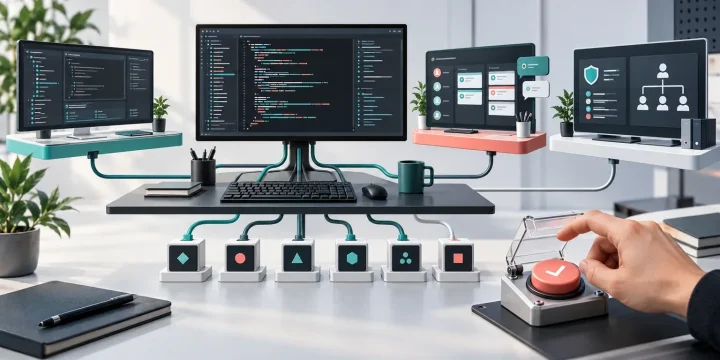
The announced system has three principal components. Air in JetBrains IDEs is intended for directing agents and reviewing their output with JetBrains’ code intelligence. Air Teams covers workflows involving developers and autonomous agents. Air Governance, previously called JetBrains Central, focuses on policies, audits, AI spending and accountability across an organization.
Junie will work across the Air products, but JetBrains says third-party agents will also be supported. The company presents Air as an expansion beyond its traditional focus on the individual developer’s IDE, addressing how AI-assisted changes are coordinated and approved across a broader software delivery process.
Connecting External Agents
JetBrains plans to use the Agent Client Protocol to connect IDEs with an agent’s planning system, tools, model routing and observability functions. Developers will be able to find compatible agents through the ACP Registry while remaining inside JetBrains IDEs.
The multi-vendor approach is also central to Air Governance. JetBrains says it is designed to provide shared context, policy enforcement, cost visibility and activity records across different models, agents and services, reducing the need to recreate controls separately for each provider.
Verification Becomes the Constraint
JetBrains argues that faster code generation shifts engineering effort toward review, coordination and ownership. Its stated concern is not only obviously broken code, but plausible changes that pass a superficial check while introducing faulty assumptions or architectural inconsistencies. Air therefore emphasizes human verification and records of how agent-produced work was created and approved.
Availability Remains Staged
JetBrains describes Air as a rolling series of releases, combining products available now with others that will arrive as the system develops. The announcement does not provide a component-by-component release schedule. Mobile and remote controls, richer context from repositories and runtime behavior, and more workflows triggered by repository events or schedules are presented as longer-term directions rather than currently available capabilities.
Source: JetBrains Air: Building a System of Products for Agentic Software Development
 SIGNAL TITANS
Leave a Reply