
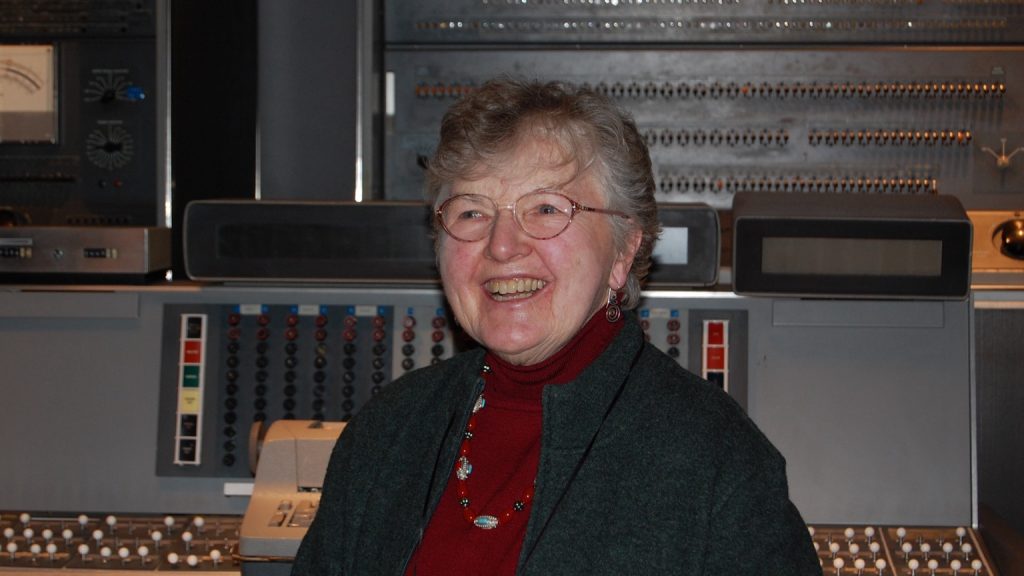
Frances Allen joined IBM for a very practical reason: she needed money to pay off her student loans. She planned to stay only a few years, then return to teaching mathematics.
She stayed for 45 years.
Along the way, she helped establish the foundations of modern compiler optimization, became the first woman to be named an IBM Fellow, and in 2006 became the first woman to receive the ACM A.M. Turing Award.
That was not the career plan.
She started as a teacher
Allen grew up on a farm in Peru, New York. She studied mathematics, became a high-school teacher and taught subjects ranging from algebra to trigonometry.
After two years, she went to the University of Michigan for a master’s degree in mathematics.
That education left her with debt.
IBM was recruiting on campus.
Allen took the job with a simple intention: pay off the loans, work for a couple of years, then go back to teaching.
Her first assignment was unexpectedly appropriate.
IBM asked her to teach programmers a new language called FORTRAN.
She was learning the material only days before teaching it
FORTRAN was still new. Allen later described having to stay only slightly ahead of the people she was teaching.
That could have been a temporary training role.
Instead, it became the doorway into a problem that would define much of her career: compilers.
A compiler takes code written in a language humans can work with and transforms it into instructions a machine can execute.
The naive version simply translates.
The interesting version understands enough about the program to improve it.
Can this computation move earlier?
Can two operations happen in parallel?
Can redundant work disappear?
Can the same program run dramatically faster without the programmer manually rewriting everything?
Those questions became Allen’s territory.
Her career grew from making other people’s code run better
Allen worked on IBM’s Stretch-Harvest effort, one of the earliest supercomputing projects. She contributed to compilers, program analysis and optimization techniques that helped machines execute programs more efficiently.
Her work on interprocedural analysis examined how different parts of a program affect one another across procedure boundaries.
Her work on automatic parallelization helped compilers identify operations that could safely run at the same time on multiple processors.
The significance is easy to miss because the result is invisible.
A programmer writes code.
The compiler quietly rearranges and optimizes it.
The machine does more work in less time.
Modern optimizing compilers still rely on ideas Allen helped establish.
The person who planned to leave kept following the work
Allen did not stay at IBM because of a meticulously designed 45-year career map.
In interviews, she described something much less strategic.
One interesting problem led to another.
She found people she liked working with.
She kept discovering questions at the edge of what computers could do.
Eventually, the temporary job became the career.
Years later, when asked what advice she would give young women entering computing, Allen’s first point was strikingly consistent with her own story:
Focus on your work, not your career.
That advice sounds dangerous in a world obsessed with career strategy
Modern professional life encourages constant optimization.
What title should I get next?
Which company looks strongest on my résumé?
Which skill will increase compensation fastest?
What should my five-year plan look like?
Those questions are not useless.
But they can create a strange failure mode: optimizing the visible shape of a career while paying too little attention to whether the actual work is making you better.
Allen’s path suggests a different unit of measurement.
Is the problem interesting enough to deepen your skills?
Are you working with people who make you think better?
Are you learning something difficult that compounds?
Are you close enough to real problems to build judgment?
A title can change in one promotion cycle.
Deep technical judgment takes years.
Careers are often clearer backward than forward
Today, Allen’s biography looks almost inevitable: mathematics, IBM, compiler research, high-performance computing, IBM Fellow, Turing Award.
Living it did not feel inevitable.
The first major step was a debt-payment plan.
The second was teaching a language that had only recently been introduced.
The long career emerged from continuing to choose work that stayed interesting.
That does not mean planning is useless.
It means a career can be built from a sequence of good local decisions without a perfect global map.
Allen intended to spend a couple of years at IBM.
She ended up helping shape how compilers make code faster — and breaking one of computing’s most visible gender barriers.
What if the best next step in your career is not the one with the most impressive title, but the one with the most interesting problem?
Sources
- IBM History — Frances Allen
- IBM Research — Remembering Frances E. Allen
- Computer History Museum — Frances Allen
- ACM-W — Spotlight on Frances E. Allen
- ACM Computing Educators Oral History Project — Fran Allen overview
- Featured image — Frances Allen at the Computer History Museum in 2011, photo by vonguard, CC BY-SA 2.0 via Wikimedia Commons. Cropped to 16:9; derivative remains CC BY-SA 2.0.
 SIGNAL TITANS
Leave a Reply