
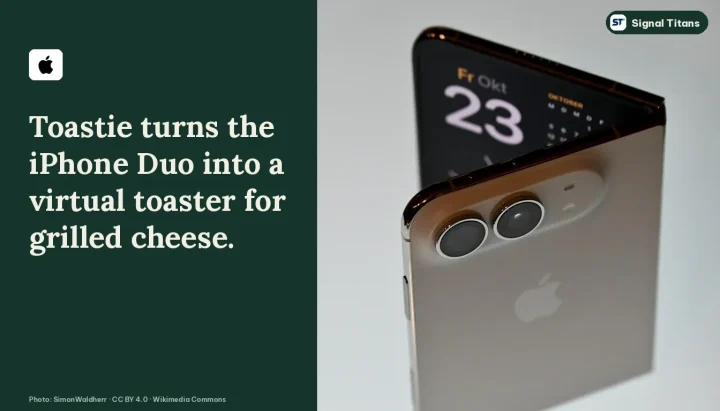
Developers are capitalizing on the novel hardware capabilities of the iPhone Duo, employing its folding form factor and dual-screen orientation to introduce creative software applications. According to reports from MacRumors, many of these titles utilize skeuomorphic design principles to turn the foldable device into physical objects like vintage computers, notebooks, and household appliances.
Retro Hardware and Nostalgic Emulators
Among the notable software releases is Tiny Computers, priced at $3.99 and developed by Fountain Interactive Ltd. According to App Store details and MacRumors, the app transforms the iPhone Duo into a miniature retro machine when bent into tabletop mode, placing the display above a working virtual keyboard. The collection features ten classic systems inspired by the Macintosh, Commodore 64, IBM PC, Amiga 500, Windows 95, ThinkPad, iMac G3, iBook G3, PowerBook G4, and Windows XP.
The software includes interactive elements like clickable keyboards, command lines, paint programs, and hidden easter eggs, functioning without ads, subscriptions, or in-app purchases. For users without a Duo, the app provides simulated perspective on regular iPhones and iPads. Additionally, popular emulation tools like the Delta Game Emulator have been updated to turn the foldable device into a dual-screen handheld resembling a Nintendo DS shell when closed.
Creative Art, Notes, and Relaxation Tools
Other developers are tailoring productivity and relaxation software to the physical layout of the Duo. TypeDraw ($4.99) acts as a digital notebook supporting Apple Pencil input, letting users customize pages, fonts, and colors. Similarly, the adult coloring book Lake provides a full-page coloring surface in portrait mode with upcoming Apple Pencil optimizations, featuring a free base version and a $9.99 per-month subscription for full access.
For ambient utility, Portal ($2.99 per month or $29.99 per year) uses the device's tent mode to display natural environments from around the world alongside meditation timers and calming sounds. Living Earth ($5.99) showcases a rotating globe, live weather maps, and storm tracking across the entire unfolded screen.
Hardware-Mimicking Games and Novelty Apps
The hardware's physical hinge inspires unique gameplay mechanics across various titles. Toastie ($2.99) turns the device into a virtual toaster where players quickly build a grilled cheese sandwich and close the phone to toast it. Fold Accordion ($2.99) and Foldissimo use the hinge as mechanical bellows to create music through physical opening and closing motions.
Other applications explore spatial interaction further, including Fold & Squish for Rorschach art, Duometry ($2.99) for angle-matching puzzles, Deck-Man ($4.99) styled as a retro cassette player, and Orisuji ($4.99) for paper mazes that transition from inner to outer displays.
What Foldable Form Factors Mean for Mobile Interaction
The emergence of creative applications tailored specifically for the iPhone Duo highlights a broader shift in how developers approach mobile user experience when physical hardware characteristics evolve. For years, consumer smartphones trended toward uniform rectangular glass slabs, constraining interface design primarily to flat, touch-based software abstractions. By introducing a mechanical hinge and dual-screen orientations, devices like the Duo invite developers to reintroduce skeuomorphism—not merely as a nostalgic visual aesthetic, but as a functional bridge between physical muscle memory and digital interactions. When closing a device can act as snapping shut a notebook, clicking a virtual toaster shut, or compressing accordion bellows, software ceases to be just a flat pane of glass and instead engages tactile intuition.
This trend suggests that as unconventional form factors mature, user engagement will increasingly rely on physical metaphors that leverage bodily motion and spatial feedback. While these novelty applications demonstrate the creative potential of folding displays, their long-term commercial viability depends on whether hardware makers standardize these multi-orientation configurations or if they remain niche novelties for enthusiasts willing to invest in specialized ecosystem software. For now, the developer community's willingness to experiment with these physical interfaces proves that hardware constraints can serve as a powerful catalyst for imaginative software design.
Cover: SimonWaldherr · CC BY 4.0 · Wikimedia Commons. Layout and headline text by Signal Titans. Logo: Apple, via Wikimedia Commons (Public domain).
Source: The iPhone Duo Can Be a Tiny Mac, a Toaster, and a Nintendo DS · Tiny Computers App – App Store
 SIGNAL TITANS
Leave a Reply