
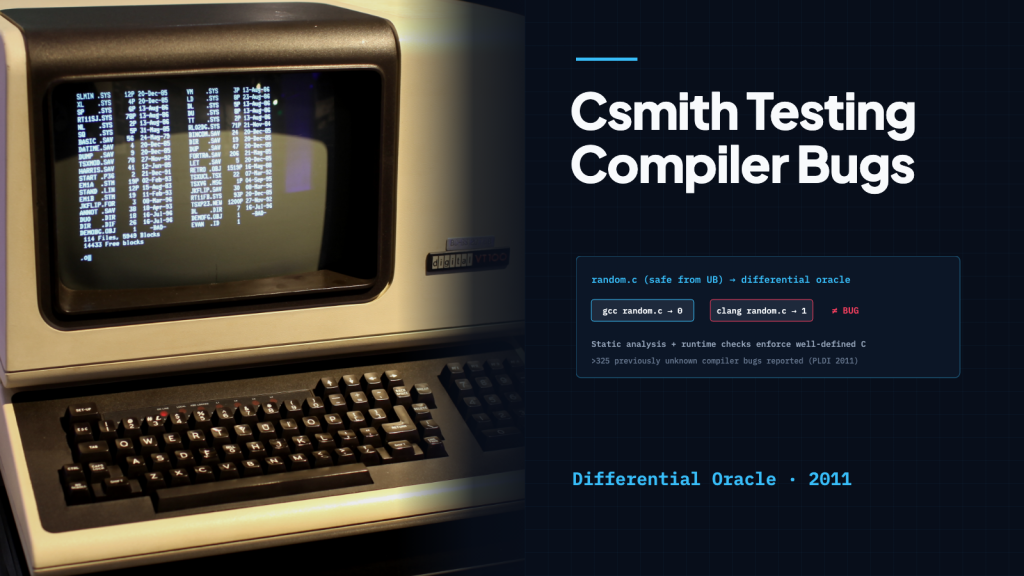
Imagine compiling an automatically generated C program with two compilers and getting different outputs: one executable prints 0 and the other prints 1. If the program avoids undefined behavior, does not depend on unspecified choices, and both compilers use compatible implementation-defined behavior, that discrepancy indicates a compiler defect. Open-sourced in 2009, Csmith made this differential testing practical: the University of Utah researchers who built it reported more than 325 previously unknown compiler bugs in their 2011 paper.
The Silent Threat of Miscompilation
Compilers occupy a trusted position in software engineering. Programmers rely on them to translate human-readable source code into machine instructions that preserve the precise semantics of the original program. A compiler defect can undermine even source code that has undergone formal verification.
Yet compilers are vast, highly intricate systems that perform dozens of delicate optimization passes. Compiler bugs can cause the compiler itself to crash, or they can cause miscompilation: the compiler completes its task cleanly, but emits machine instructions that produce incorrect behavior. Miscompilations typically occur without any compiler warning. Detecting such silent defects is exceptionally difficult because conventional software testing depends on an oracle—a known benchmark or expected output against which a test run can be judged.
Turning Disagreement into a Test Oracle
To break this testing bottleneck, a research team at the University of Utah—Xuejun Yang, Yang Chen, Eric Eide, and John Regehr—developed Csmith. Csmith tackled the oracle problem through randomized differential testing. Instead of attempting to calculate the expected behavior of a complex synthetic program ahead of time, Csmith generated random C programs and compiled each one with multiple distinct compilers, different versions of the same toolchain, or the same compiler invoked with different optimization flags.
By running the resulting executables and comparing their console outputs, this approach turned compiler divergence into an automated test oracle. If the GNU Compiler Collection (GCC) and Clang agreed on the output, the test yielded no immediate signal. But if one binary printed a different number or crashed while the other terminated normally, the disagreement pointed directly to a defect in one of the compilers—or, in rare cases, a flaw in Csmith’s own generator.
Navigating the Minefield of Undefined Behavior
Generating random C programs is far harder than generating programs in memory-safe languages. The C language standard contains categories of undefined and unspecified behavior, ranging from signed integer overflow and shifts by negative offsets to uninitialized variable access and null-pointer dereferences. When a program executes undefined behavior, the C standard frees the compiler from all behavioral obligations; an optimizing compiler can legally assume that undefined operations never occur, reshaping or deleting entire blocks of code.
Random C syntax alone would not provide the semantic safeguards needed for differential testing. The Utah researchers designed Csmith to exercise pointers, arrays, control flow, structs, and expressions while using static analysis and runtime checks to avoid undefined behavior and dependence on unspecified choices. Comparisons also required compatible implementation-defined behavior, such as integer widths and representations. Because well-defined C programs can still execute infinite loops, Csmith’s testing harness coupled its semantic guardrails with strict execution timeouts.
Hundreds of Previously Unknown Flaws
In their paper for the 2011 ACM SIGPLAN Conference on Programming Language Design and Implementation (PLDI), titled “Finding and Understanding Bugs in C Compilers,” the authors reported more than 325 previously unknown compiler bugs found during three years of testing. On March 18, 2011, while announcing completion of the camera-ready paper, Regehr wrote on his research blog that the total had reached 344 reported bugs after the paper’s statistics were frozen.
Across the study, every tested compiler had versions that crashed and silently miscompiled valid C programs. Csmith found wrong-code bugs in the unverified front end of earlier CompCert versions, but none in the under-development version tested in early 2011. Most GCC bugs were in its middle end, while LLVM also had substantial front-end and back-end defects. The authors identified incorrect optimization safety checks as the most common root cause among the bugs they examined.
Testing the Limits of Formal Verification
Csmith also provided an independent test for formally verified software. The Utah researchers subjected CompCert—an optimizing C compiler developed by Xavier Leroy and his collaborators, whose core passes are proved mathematically correct using the Coq proof assistant—to extensive randomized testing. In early 2011, after dedicating approximately six processor-years of randomized execution to testing under-development builds of CompCert, Csmith was unable to find a single wrong-code defect in CompCert’s verified middle-end passes.
The result provided concrete empirical evidence that machine-checked mathematical proofs offer real protection against miscompilation. At the same time, the researchers and CompCert’s own documentation carefully articulated the real-world boundaries of verification. CompCert’s mathematical proofs covered its verified compilation passes from abstract syntax trees to assembly representations, leaving unverified stages such as preprocessing, parsing, assembling, and linking outside the formal proof boundary.
Finding Bugs Without Knowing the Answer
Csmith showed that expressive random programs could find defects missed by existing compiler test suites. Randomized compiler testing had a long history, dating back decades to earlier differential testing tools. Csmith’s contribution was to combine a broad range of C language features with systematic safeguards against undefined behavior and dependence on unspecified choices.
The study demonstrated a practical benefit of differential testing: it exposed hundreds of previously unknown bugs across open-source and commercial compilers, and most reported defects were fixed. For software engineers testing complex systems, the enduring lesson is that independent implementations can serve as effective critics of one another, provided the inputs are strictly constrained to avoid ambiguous behavior.
Related stories
Sources
- Xuejun Yang, Yang Chen, Eric Eide, and John Regehr, “Csmith: A Random Generator of C Programs,” GitHub repository and project documentation
- John Regehr, “Finding and Understanding Bugs in C Compilers,” Embedded in Academia, March 18, 2011
- John Regehr, “A Guide to Undefined Behavior in C and C++, Part 1,” Embedded in Academia, July 9, 2010
- CompCert Team, “Chapter 1: CompCert C: A Trustworthy Compiler,” CompCert User’s Manual
- Wikipedia, “Csmith,” overview of the test case generation tool
- Featured image: Jason Scott; Wikimedia Commons; CC BY 2.0 (adapted from the original)
 SIGNAL TITANS

Leave a Reply