
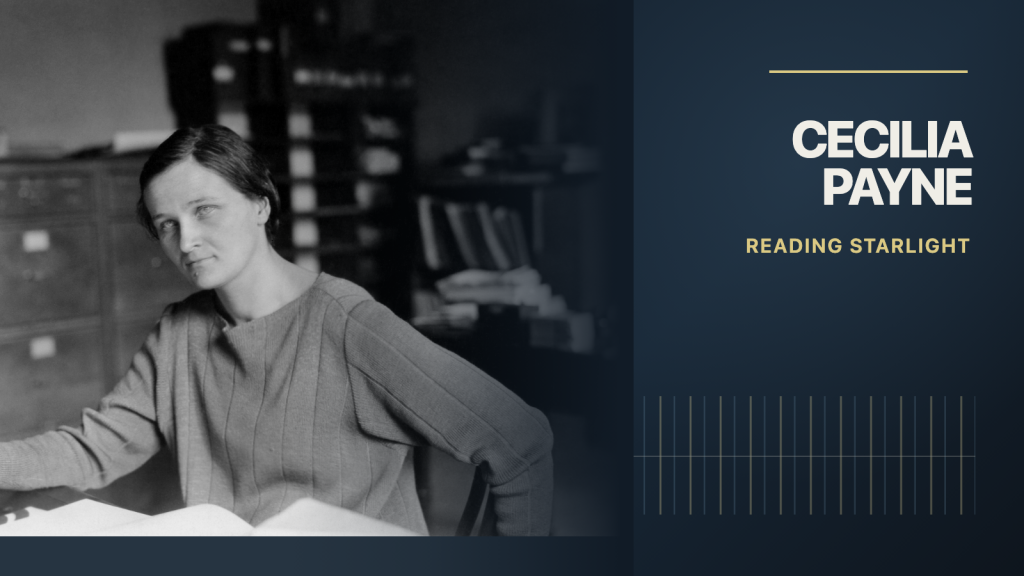
For a long time, astronomers could look at the dark lines in a star’s spectrum and identify elements without knowing how much of each element was actually there. A strong line did not necessarily mean an element was abundant. A weak line did not necessarily mean it was rare.
In 1925, Cecilia Payne used a new physical framework to reinterpret those lines. Her doctoral work showed that temperature and ionization could dramatically change the appearance of a spectrum. Once those effects were accounted for, the conclusion was startling: hydrogen and helium were vastly more abundant in stars than the heavier elements familiar on Earth.
The discovery was not a new photograph of the sky. It was a better way to read evidence astronomers already had.
The old data contained a new answer
Payne arrived at the Harvard College Observatory in 1923 after studying at Cambridge, where opportunities for women to build an astronomy career were limited. Harvard had something unusually valuable: a vast archive of stellar spectra recorded on photographic plates and a research tradition built around classifying them.
Spectra act like fingerprints of matter because atoms absorb and emit light at characteristic wavelengths. But the strength of a spectral line depends on more than how much of an element exists. It also depends on the physical state of the atoms producing the line.
That distinction became crucial after Indian physicist Meghnad Saha developed an ionization equation connecting temperature and pressure to the fraction of atoms that lose electrons. Payne recognized that Saha’s work could turn stellar classification into a quantitative physical problem. Instead of treating spectral differences mainly as differences in composition, she could ask how much of a difference came from temperature and ionization.
She separated appearance from abundance
Hydrogen provides the cleanest example. The familiar Balmer lines of hydrogen are produced only when electrons occupy a particular excited state. At the temperature of the Sun, only a tiny fraction of hydrogen atoms are in that state at any one moment. The visible line can therefore underrepresent the total amount of hydrogen present.
Payne applied this reasoning across stellar spectra in her 1925 thesis, Stellar Atmospheres. She found that many heavier elements appeared in broadly comparable proportions to terrestrial material, but hydrogen and helium stood out as enormously more abundant than expected.
That result challenged a common assumption of the period: that stars had roughly the same overall elemental mixture as Earth, with spectral differences reflecting modest changes around that baseline. Payne’s analysis implied something much more radical. The ordinary matter in stars was dominated by the two lightest elements.
A surprising result can be technically correct and socially difficult
Payne’s conclusion met resistance. Henry Norris Russell, one of the leading astronomers of the time, urged caution because the inferred abundance of hydrogen and helium seemed too extreme compared with the accepted picture. In the published thesis, Payne therefore described the enormous derived abundances as probably not physically real.
The important nuance is that she did not simply make a guess that others later proved. Her calculation was already pointing in the right direction. The uncertainty was about whether such an unexpected result should be trusted over the prevailing model.
Within a few years, Russell’s own work supported the high abundance of hydrogen. The field moved toward the view that Payne’s analysis had uncovered a basic fact about stellar composition. Modern astrophysics treats hydrogen and helium as the dominant constituents of stars and of ordinary baryonic matter in the universe.
The thesis mattered because it changed the meaning of a measurement
This is why Payne’s work is more than a story about being right before a senior scientist. Its deeper importance is methodological.
A measurement does not interpret itself. A spectrum is a pattern of light. Turning that pattern into temperature, pressure and chemical abundance requires a model of how atoms behave. If the model is incomplete, the same data can support the wrong story.
Payne connected observational astronomy with atomic physics at exactly the moment when quantum ideas were making that connection possible. The result helped establish stellar atmospheres as a field in which spectra could be read quantitatively rather than treated mainly as descriptive categories.
Her later career extended far beyond the thesis. She became a major researcher on variable stars and, in 1956, the first woman promoted to full professor from within Harvard’s Faculty of Arts and Sciences and the first woman to chair a Harvard department.
The enduring lesson is calibration, not hero worship
It is tempting to turn Payne’s story into a simple moral about ignoring authority. That would miss the more useful lesson. Science advances neither by obeying consensus automatically nor by rejecting it automatically. It advances by understanding which assumptions connect observations to conclusions.
Payne changed the answer because she changed that connection. She asked what the spectrum should look like after accounting for temperature and ionization, then compared that physical model with the plates.
The same habit matters in data work today. A dashboard, sensor or model output is never just “the facts.” It is evidence filtered through measurement conditions and assumptions. When a result looks impossible, the right response is not to celebrate the anomaly or suppress it. The right response is to inspect the calibration carefully enough to learn whether the anomaly is revealing a flaw in the data, a flaw in the model, or something genuinely new.
Sources
- Harvard-Smithsonian Wolbach Library — Education and Doctoral Thesis
- Harvard University Archives — Papers of Cecilia Helena Payne-Gaposchkin
- American Physical Society — Cecilia Payne-Gaposchkin and the Day the Universe Changed
- Smithsonian National Air and Space Museum — From “Computer” to Astronomer
- NASA ADS / Harvard Observatory — Stellar Atmospheres, 1925
- Featured portrait — Cecilia Payne-Gaposchkin, Science Service / Smithsonian Institution, via Wikimedia Commons; public domain in the United States.
 SIGNAL TITANS
_-_Science_Service.jpg)
Leave a Reply