
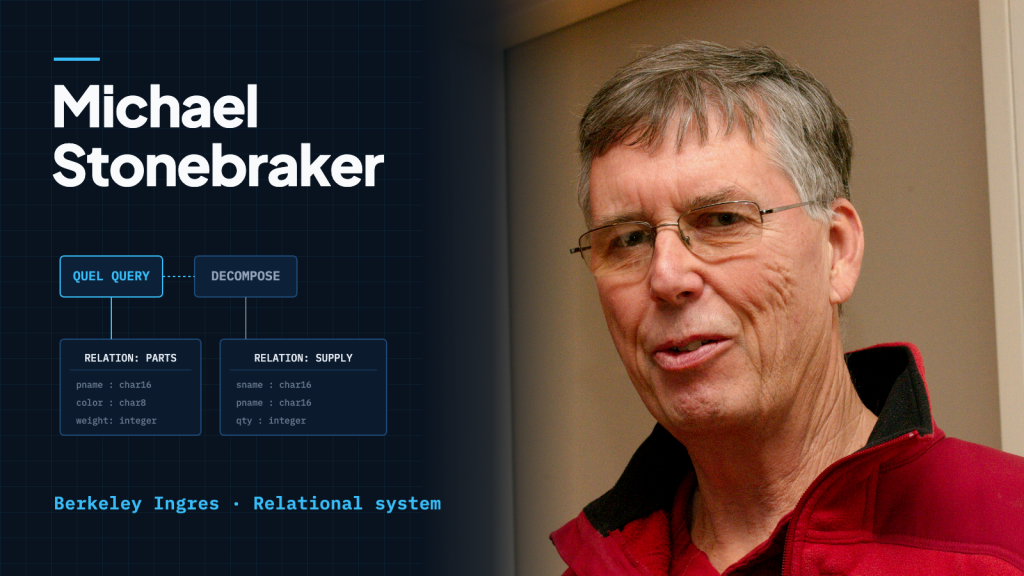
In 1974, Michael Stonebraker and Eugene Wong’s Ingres project at the University of California, Berkeley, demonstrated an initial implementation of Edgar F. Codd’s relational database ideas. According to the National Research Council’s 1999 history, significant revisions followed to make the code maintainable.
Stonebraker, Wong, and their colleagues continued developing Ingres after the initial implementation. They repeatedly rewrote the prototype to incorporate accumulated experience, user feedback, and new ideas. Public source code, researchers moving into industry, and publications subsequently helped spread Ingres technology.
Navigational Databases Before Codd
In the early 1970s, managing computerized business records meant navigating the database step by step. Programmers relied on hierarchical engines like IBM’s Information Management System (IMS) or network-model databases standardized by the Conference on Data Systems Languages (Codasyl). To retrieve records, developers specified navigational steps through the database. This could tie application programs to details of data organization, making changes harder.
In 1970, mathematician Edgar F. Codd at IBM Research published a landmark paper proposing a radical alternative. Codd argued that data should be represented as mathematical relations—simple tables of rows and columns—free from physical storage details. Instead of writing code to navigate disks, users would issue declarative queries stating what data they wanted, leaving retrieval planning to the database management system. However, IBM’s financial and organizational investment in IMS created resistance to adopting a competing technology.
Assembling Support for a Practical System
Around 1973, Stonebraker and Wong became fascinated by Codd’s proposals. At Berkeley, their initial fundraising was directed toward building a geographic data retrieval system for the university’s economics group, an origin preserved in the project’s name: Interactive Graphics and Retrieval System, or Ingres. When Stonebraker approached the Defense Advanced Research Projects Agency (DARPA) and the Office of Naval Research (ONR) for funding to build a complete relational database, both organizations declined because they were already sponsoring database projects elsewhere.
Stonebraker refused to abandon the concept. With assistance from Wong and Berkeley colleague Lotfi Zadeh, he assembled modest financial backing from the National Science Foundation (NSF) and three military bodies: the Air Force Office of Scientific Research, the Army Research Office, and the Navy Electronic Systems Command. That patchwork of funding let the Berkeley group pursue a complete relational system.
Rewriting Code for Maintainability
After the 1974 demonstration, the work shifted from proving the relational idea to making the code something people could maintain. In the National Research Council’s account, that meant significant revisions, not a single finished build.
Ingres was a team effort. Between 1973 and 1979, roughly thirty people passed through the Ingres group, which never contained more than five or six programmers simultaneously. The original design paper credits M. Stonebraker, G. Held, E. Wong, and P. Kreps. The 1977 reference manual credits K. Youssefi, N. Whyte, M. Ubell, D. Ries, P. Hawthorn, B. Epstein, R. Berman, and E. Allman.
The team developed query decomposition techniques and created QUEL, a declarative query language: users specified the data they wanted rather than the steps for retrieving it. QUEL was based on tuple relational calculus, a mathematical way to describe the desired records, and competed with IBM’s Structured English Query Language (SEQUEL), later called Structured Query Language (SQL).
Spreading the Architecture Worldwide
A crucial factor in Ingres’s influence was Berkeley’s decision to distribute source code freely. Ingres source code was publicly available, and about 1,000 copies were distributed worldwide so that computer scientists and programmers could experiment with and adapt the system. The spread of inexpensive Digital Equipment Corporation (DEC) computers in universities helped its dissemination. IBM’s System R research also influenced the field through publications and the work of its researchers.
In 1980, Stonebraker, Wong, and Lawrence Rowe founded Relational Technology, Inc., later renamed INGRES Corporation, to commercialize the Berkeley code. Members of the Ingres team went on to found or lead major database companies, including Sybase, Britton-Lee, and Illustra. Implementation of POSTGRES, led by Stonebraker at Berkeley, began in 1986 and extended relational systems to support more complex data. In 1994, Andrew Yu and Jolly Chen added an SQL interpreter to POSTGRES. The system was subsequently released to the web as Postgres95, and the project adopted the name PostgreSQL in 1996.
Why Ingres’s Revisions Mattered
The history of Ingres illustrates how continued revision carries an experimental system beyond its initial demonstration. Making code maintainable was central to that work, alongside sharing source code, publishing findings, and transferring experience into commercial systems.
A working query tests the concept; maintaining and adapting the code over years tests the engineering design.
Related stories
Sources
- National Research Council (1999), Funding a Revolution: Government Support for Computing Research, Chapter 6: The Rise of Relational Databases, pp. 162–166.
- Adam Conner-Simons (2015), Michael Stonebraker wins $1 million Turing Award, MIT News, March 25, 2015.
- University of California, Berkeley, Department of Electrical Engineering and Computer Sciences, Eugene Wong Faculty Home Page.
- K. Youssefi, N. Whyte, M. Ubell, D. Ries, P. Hawthorn, B. Epstein, R. Berman, and E. Allman (1977), Ingres Reference Manual- Version 6.1, UC Berkeley Electronics Research Laboratory, Memorandum No. UCB/ERL M579.
- PostgreSQL Global Development Group (2026), A Brief History of PostgreSQL, PostgreSQL 18 Documentation, Chapter 2.
- Featured image: Dcoetzee; Wikimedia Commons; CC0 (adapted from the original)
 SIGNAL TITANS

Leave a Reply