
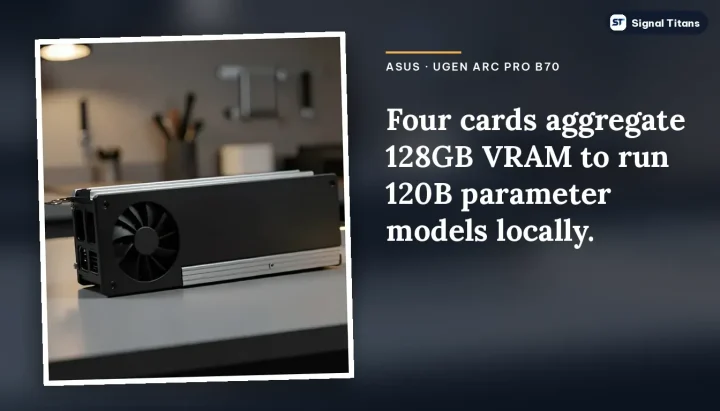
ASUS has officially entered the Intel discrete graphics landscape by unveiling the UGen Arc Pro B70 32 GB, marking the company’s first Intel-based graphics card release since its passively cooled Iris Xe DG1-4G in 2021. Rather than routing the product through traditional consumer series like ProArt, ASUS has categorized the hardware under its specialized UGen AI accelerator lineup, signaling a dedicated pivot toward workstation and local machine learning workloads. While Intel originally launched the foundational Arc Pro B70 architecture earlier in the year at a base price of $949, and current US retail pricing hovers near $1,300, ASUS has yet to disclose specific pricing or an official release date for its custom iteration.
Hardware Architecture and Power Discrepancies
Under the hood, the ASUS card relies on the complete Big Battlemage BMG-G31 silicon die, packed with 32 Xe2 cores and 256 dedicated XMX AI engines designed specifically for professional inference tasks. The hardware is equipped with 32 GB of GDDR6 error-correcting code memory operating across a 256-bit bus, delivering a memory bandwidth of 608 GB/s and interfacing via PCIe Gen5 x16 slots. ASUS specifies a maximum boost clock of 2,800 MHz and a rated performance ceiling of up to 367 INT8 TOPS. Technical reporting and official specifications show minor variations regarding power consumption: initial technical breakdowns cite a board power of 290 W sitting at the upper end of Intel's standard operating range, whereas official product documentation from ASUS lists a typical board power of 310 W.
Thermal Engineering and Physical Build Quality
To handle sustained high-load workloads, ASUS has integrated a custom physical and thermal layout tailored for high-density workstation environments. The card utilizes a compact dual-slot blower configuration equipped with dual-ball fan bearings, which are rated to last up to twice as long as conventional sleeve-bearing designs. Thermal dissipation is further enhanced by a phase-change GPU thermal pad engineered to melt and fill microscopic gaps between the chip and the cooling module. For structural integrity, the hardware incorporates an ASUS GPU Guard featuring four-corner adhesive reinforcement on the die to mitigate cracking risks, alongside a hardened 304 stainless steel mounting bracket designed to resist corrosion. Practical integration is aided by a far-end power connector layout intended to streamline cable management across diverse chassis configurations.
Scalability, Software Integration, and Market Rivalry
The UGen Arc Pro B70 is heavily optimized for multi-GPU scalability, allowing professionals to pair up to four cards together to aggregate 128 GB of combined VRAM. According to manufacturer specifications and community documentation, this multi-card configuration provides sufficient capacity to run large language models and multi-agent systems scaling up to 120 billion parameters, such as gpt-oss-120b and advanced mixtures-of-experts architectures. ASUS pairs the hardware with tailored local software ecosystems, including the single-card Zenni Claw assistant and the multi-GPU SuperClaw platform designed to handle tensor-parallel agent fleets while reducing cloud token overhead. In the broader market, ASUS joins other hardware manufacturers like ASRock, Sparkle, and Maxsun that have already introduced their own B70 variants, meaning ultimate market adoption will likely hinge on final pricing and regional availability.
Understanding the Shift Toward Local AI Workstations
The introduction of a specialized 32 GB Intel Arc card under the UGen AI umbrella reflects a broader, strategic pivot among major hardware vendors toward local, privacy-first machine learning infrastructure. By completely bypassing early consumer Battlemage and Alchemist generations for desktop gaming, ASUS is explicitly acknowledging that the most lucrative and rapidly expanding demand for discrete graphics now lies outside traditional gaming circles, concentrated instead within professional AI development, enterprise departmental RAG systems, and autonomous multi-agent workloads. Deploying high-capacity ECC VRAM paired with robust multi-GPU scaling options allows developers and small businesses to execute sizable models locally, mitigating data privacy concerns and curbing recurring cloud API subscription costs. However, because Intel's underlying architecture faces stiff competition from established enterprise accelerators and fluctuating retail pricing, the success of the ASUS UGen variant will depend heavily on competitive pricing strategies and robust software ecosystem support. As local inferencing becomes a core requirement for enterprise environments, hardware launches tailored specifically for agentic execution pipelines represent a critical milestone in shaping how modern machine learning workloads are deployed outside hyperscale data centers.
Cover: AI-generated illustration with headline text; not a documentary photograph.
Source: ASUS Makes Its First Intel Arc Card, a 32 GB Arc Pro B70 Under the UGen AI Brand · ASUS UGen Intel® Arc™ Pro B70 32GB GDDR6
 SIGNAL TITANS
Leave a Reply