
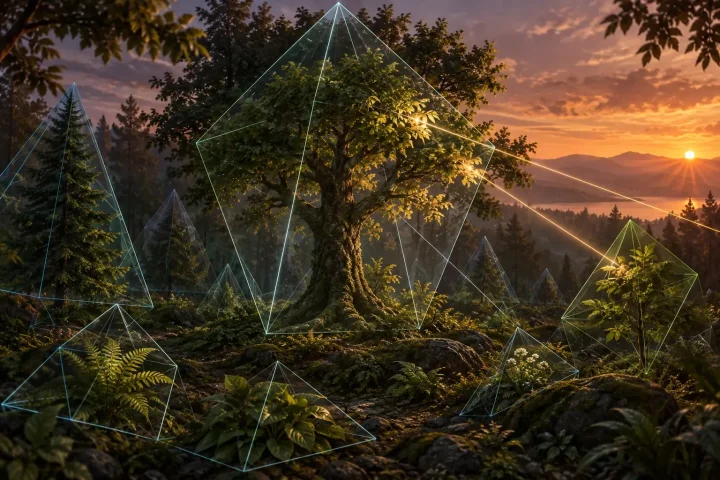
AI-generated editorial illustration; not a documentary photograph.
AMD researchers say a tetrahedral-cage rendering technique can reduce ray-tracing memory use by 98% in scenes filled with animated vegetation. In a demonstration involving about 25,000 independently animated plants, the approach used 1.7 GB of memory for bounding volume hierarchies, or BVHs, while updating them in approximately 3.3 ms per frame.
The work remains a research demonstration rather than an announced feature for a shipping game or AMD graphics product. Its potential audience is developers building dense, animated environments where conventional ray-tracing data structures impose high memory and processing costs.
Replacing Dense Deformation
The technique surrounds detailed geometry with a simpler tetrahedral cage. During animation, the cage deforms while the underlying triangle geometry and its BVH remain static and reusable. Rays are transformed into the static reference frame before intersecting the detailed mesh, making the animation workload depend on cage complexity instead of the object's full triangle count.
Large Difference in the Demo
According to the reported AMD figures, a conventional version of the plant scene could require 80 GB of GPU memory and take a Radeon RX 9070 XT about 300 ms per frame to update the BVH. The cage-based demonstration reduced those measurements to 1.7 GB and about 3.3 ms. These are research-demo results, not independent benchmarks or performance guarantees for games.
Control Is the Tradeoff
Simplifying deformation also removes control over every vertex. That limitation may be acceptable for fields, forests and other scenes where developers need large volumes of broadly similar motion, but it makes the method less suitable when an individual plant or character requires precise, distinctive animation.
Developer Tools Are Still Planned
AMD's team is working on DXR samples and a header-only C++ library for constructing tetrahedral cages around skinned, keyframe-animated and static objects. The source provides no release date or availability details for those tools. Further technical information is available in the open-access paper “Ray Tracing Massive Amounts of Animated Geometry.”
 SIGNAL TITANS
Leave a Reply