
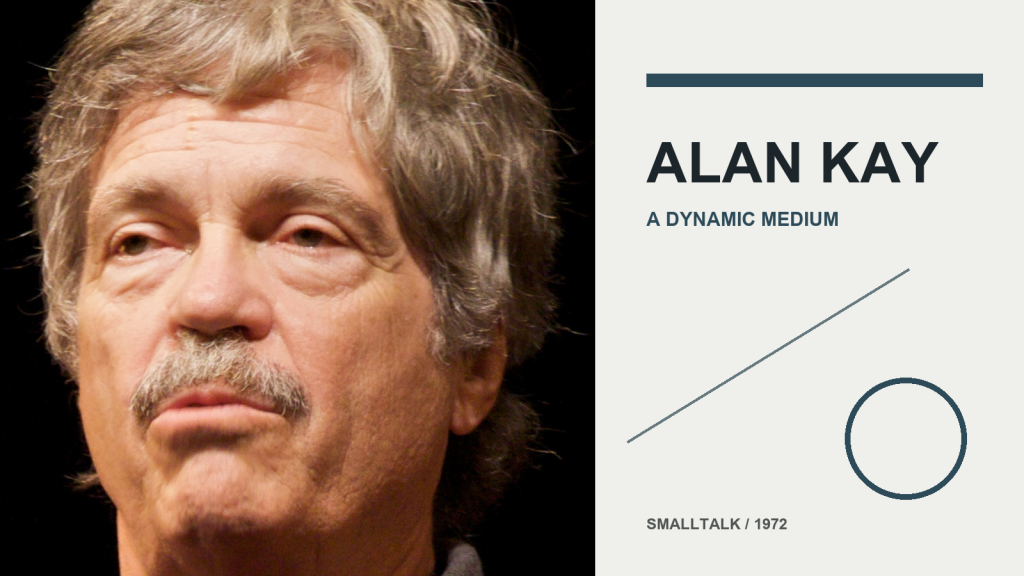
In the early 1970s, Alan Kay was not trying to make a better office terminal. He was imagining a computer that a child could carry, explore, and program — a “personal dynamic medium” rather than a machine that merely delivered finished software. That idea led toward the Dynabook concept and helped shape the work of the Learning Research Group at Xerox PARC.
The surprising part is that the programming language was not the destination. Smalltalk was infrastructure for a larger bet about what personal computing should feel like.
The computer as a medium
Kay’s background crossed mathematics, biology, music, graphics, and computer science. By the time he reached Xerox PARC, he was thinking about computers less as calculation devices and more as media that users could reshape. His 1972 Dynabook proposal described a portable personal computer for learning and creative work. The hardware of the period could not yet deliver the thin, inexpensive machine he imagined, but PARC’s Alto workstations offered a place to test many of the ideas in software.
For Kay, a truly personal computer could not be personal only because one person owned it. The user needed to be able to change its behavior. That requirement pushed the team toward a programming environment simple enough to experiment with interactively but powerful enough to build the environment itself.
Smalltalk was built for live change
The earliest Smalltalk systems emerged in Kay’s Learning Research Group in 1972, with major implementation work by Dan Ingalls and important contributions from Adele Goldberg, Ted Kaehler, Diana Merry, and others. Smalltalk combined a programming language, a development environment, and a graphical user interface. Instead of treating program creation as a long cycle of editing text, compiling, linking, and restarting, the system encouraged programmers to inspect and alter a running world.
That mattered because the interface and the language reinforced each other. Windows, menus, browsers, graphics, and direct manipulation were not isolated demos. They were parts of an environment in which objects could respond to messages and be changed while the system was alive. Later versions, especially Smalltalk-76 and Smalltalk-80, refined the model that became widely known outside Xerox.
What the team actually changed
Smalltalk helped normalize several ideas that now seem ordinary. Programs could be explored through browsers. Graphical objects could be manipulated directly. A developer could modify behavior and immediately see the result. The system encouraged object-oriented design, but Kay later emphasized that his own interest centered strongly on messaging and late binding rather than simply putting data and methods into classes.
This distinction matters because “object-oriented” eventually became a very broad label. Smalltalk’s influence was not just a recipe for class hierarchies. It was an attempt to make software systems more malleable by breaking them into communicating parts and by making the programming environment itself inspectable.
The famous PARC story is bigger than a demo
Popular retellings often compress Xerox PARC into the moment when Apple engineers saw a graphical interface and took the idea to the Macintosh. The visit mattered, but the history is broader. PARC researchers were working on bitmap displays, windows, Ethernet, laser printing, document systems, and networked personal computers. Smalltalk sat inside that larger ecology. The interesting lesson is not that one company “invented the future” and another copied it. It is that a research environment can make multiple technologies reinforce one another until a new way of computing becomes visible.
Kay’s team also treated children as serious users. That was unusual. If children were expected to create with computers rather than simply consume content, the system needed a different kind of accessibility — not just easier buttons, but understandable building blocks.
Influence without a straight line
Smalltalk did not become the dominant language of personal computing. Yet many later systems borrowed or reinterpreted its ideas: graphical development tools, object-oriented languages, integrated environments, model-view-controller patterns, live inspection, and interactive programming. The Computer History Museum describes Smalltalk as a language, environment, and GUI whose development helped shape modern personal computing. In 2003, the ACM awarded Kay the A.M. Turing Award for pioneering ideas at the roots of modern object-oriented programming, leading the team that developed Smalltalk, and making fundamental contributions to personal computing.
That recognition should not turn the story into hero worship. Kay worked in a network of researchers, and the implementation history of Smalltalk is inseparable from Ingalls, Goldberg, Kaehler, Merry, and others. The useful pattern is organizational: a strong vision mattered, but so did a team capable of turning abstractions into systems that people could touch.
The mental model worth keeping
Kay’s enduring idea was that computing should remain open to modification by its users. Modern software often moves in the opposite direction: polished, secure, convenient, and increasingly opaque. There are good reasons for that shift, especially at global scale. But the Smalltalk story preserves a valuable question for software builders.
When we simplify a product, are we making complexity understandable — or merely hiding it? A personal computer can be easy to use because users never see its machinery. Kay’s more ambitious version was different: make the machinery approachable enough that users can learn to change it.
Sources
- Computer History Museum, Alan Kay profile
- Computer History Museum, Smalltalk at 50
- Computer History Museum, Smalltalk Zoo
- NSF, Turing Awardees — Alan Kay
- The Evolution of Smalltalk
- Featured image: Marcin Wichary, Wikimedia Commons, CC BY 2.0
 SIGNAL TITANS
_(cropped).jpg)
Leave a Reply