
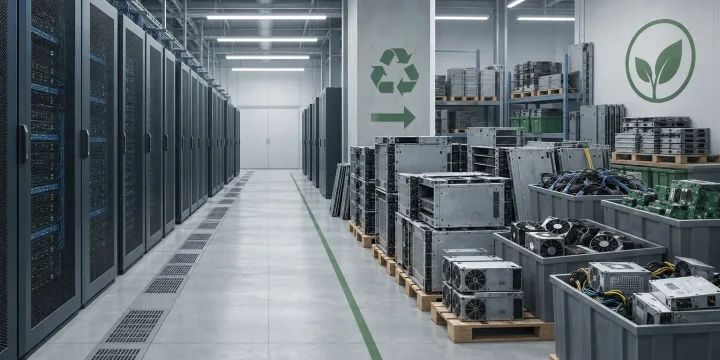
AI-generated editorial illustration; not a documentary photograph.
AI-related infrastructure could produce between 395 million and 617 million metric tons of electronic waste from 2025 through 2050, according to a report from the nonprofit Basel Action Network (BAN) covered by The Verge. The estimate includes far more than discarded servers and GPUs, extending to the electrical, cooling, backup-power and networking equipment required to operate data centers.
A Wider Accounting of AI Waste
BAN estimates that AI will contribute about 15 to 20 percent of global e-waste by 2050. Its forecast translates to roughly 8.6 million to 13.1 million metric tons of AI-related equipment being retired annually and about 70,000 metric tons of waste for each gigawatt of data center capacity.
The report also introduces a broad category called “AI Waste Contagion,” covering telecommunications infrastructure and personal devices that BAN expects could be replaced earlier because of advances in AI. Including those indirect effects helps explain why its totals substantially exceed previous estimates.
Forecast Depends on Data Center Growth
The calculation draws on a McKinsey projection that total data center capacity could reach as much as 219GW by 2030. BAN says earlier research focused on servers and accelerators while omitting about 87 percent of a data center’s electro-mechanical infrastructure.
By comparison, a 2024 study estimated AI e-waste could reach 1.2 million to 5 million tons by 2030. Another study published in February projected that AI servers alone could generate 131,000 to 225,000 tons annually by the end of the decade. These studies use narrower scopes and different time horizons, so their figures are not directly equivalent to BAN’s cumulative forecast.
Recycling Capacity Lags
BAN forecasts total global e-waste, including non-AI sources, could triple to as much as 211 million metric tons per year by 2050. Today, less than one-quarter of the 68.3 million tons generated annually is formally collected and recycled, according to the report.
Hazardous Exports Remain a Risk
The report raises particular concerns about equipment entering informal recycling systems, where burning or burial can expose workers and surrounding environments to lead, chromium and other toxic materials. The United States, which has more data centers than any other country, has not ratified the Basel Convention restricting international trade in hazardous waste, and investigations cited by The Verge found that US recyclers continue to export e-waste.
Source: The AI data center e-waste problem is huge — and getting bigger
 SIGNAL TITANS
Leave a Reply