
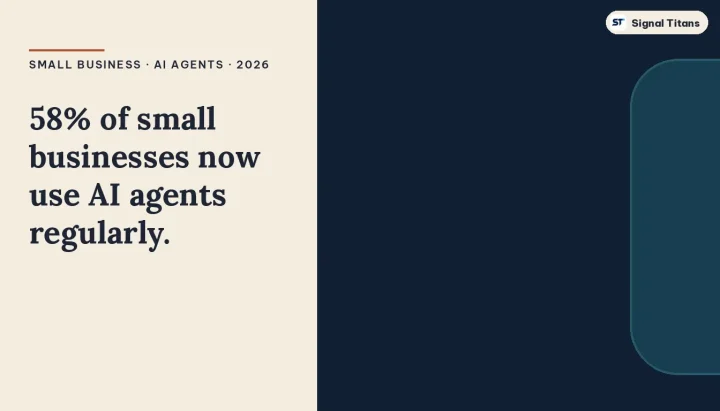
According to a recent Small Business and Entrepreneurship Council survey conducted in October 2026 among 516 employers, 58% of small businesses now use AI agents regularly or occasionally, with another 14% planning to start. This macro trend is further reinforced by major platform releases, such as Meta introducing agent tools designed specifically for time-pressed owners. While early tech discussions treated AI agents as a futuristic novelty, recent operational data shows they have quietly integrated into daily workflows, transforming from conference-stage vocabulary into standard operational line items.
Where AI Agents Succeed and Fail in Daily Operations
Testing by small business operators reveals a clear operational divide between predictable tasks and complex scenarios. While agents easily handle straightforward happy paths—such as polite lead follow-ups, meeting preparation, and routine customer inquiries—they frequently falter on edge cases and ambiguous human phrasing. According to operational playbooks, owners achieve the best results by starting with a single repetitive workflow, such as customer support triage or inbox sorting, rather than trying to automate multiple administrative tasks simultaneously. Industry data highlights seven primary jobs frequently handed off first, which also include review reply drafting, scheduling reminders, bookkeeping preparation, and generating first-draft content.
Common Pitfalls, Cost Risks, and Implementation Mistakes
Despite clear efficiency gains, practical testing highlights several operational hazards. Subscription fees can scale unexpectedly if usage-based platforms charge per action or compute minute, and poorly configured agents can burn through credits in infinite loops if left unmonitored. Furthermore, data privacy remains a critical concern when routing customer conversations through third-party vendors, requiring careful auditing of data policies before inbox integration. Industry playbooks caution against four frequent mistakes: letting agents manage customer relationships without personal customization, skipping human review for financial commitments or policy promises, feeding agents outdated pricing data, and attempting to automate broken processes before fixing them manually.
Why This Matters for Small Business Operations
The widespread adoption of AI agents marks a fundamental transition in how lean commercial teams handle administrative overhead, moving the technology from theoretical demonstrations into concrete operational budgets. Rather than replacing human judgment, these tools function more like junior staff members, absorbing repetitive tasks like email triage and scheduling while leaving strategic decisions to human operators. For small business owners, the core economic calculation relies on recovering billable hours or capturing prospective leads that might otherwise slip through the cracks during high-volume periods. However, this reliance on automated workflows introduces new vulnerabilities, including data privacy exposures and the risk of depersonalizing client interactions if automated text goes out unreviewed. Ultimately, the success of these deployments depends heavily on maintaining strict operational boundaries, ensuring that financial agreements, customer disputes, and unique brand voices remain under direct human supervision. As consumer platforms bake agent capabilities directly into existing communication suites, the competitive pressure to adopt these tools will intensify, forcing businesses to carefully balance efficiency gains against the hidden costs of setup, continuous oversight, and potential brand erosion.
Editorial graphic and headline text by Signal Titans.
Source: What I learned testing AI agents for my small business · AI Agents for Small Business: The 2026 Playbook
 SIGNAL TITANS
Leave a Reply