
Africa’s technological landscape is witnessing a growing push into deep tech, characterized by companies designing physical infrastructure, autonomous systems, and advanced hardware rather than purely digital applications. While software and fintech have traditionally commanded the lion's share of attention and capital across the continent, high-profile ventures such as Nigerian defence technology startup Terra Industries are demonstrating the viability of hard tech development locally, according to reports by TechCabal and Briter Intelligence.
Manufacturing and Import Bottlenecks
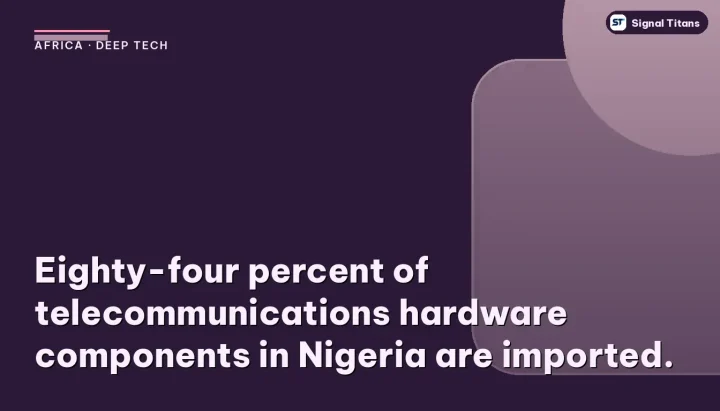
Building deep tech locally requires navigating significant supply chain complexities. Unlike software firms that leverage existing cloud infrastructure and foreign digital networks, hardware and deep tech enterprises must design, prototype, and manufacture physical components. Data cited by TechCabal from a Nigerian Communications Commission baseline study indicates that 84% of telecommunications hardware components in Nigeria are imported. Startups relying on specialized printed circuit boards, semiconductors, and electronic parts face substantial exposure to international shipping costs, foreign exchange fluctuations, and customs duties.
Furthermore, Africa's overall production capacity in foundational technologies remains constrained. According to the African Academy of Sciences referenced in regional reporting, the continent accounts for less than 1% of global semiconductor economic output, with local participation heavily concentrated in design and testing rather than fabrication. Similarly, data shows that Africa accounts for roughly 0.6% of global data-centre capacity, underscoring the infrastructural gap facing advanced computing and artificial intelligence initiatives.
Capital Distribution and Structural Gaps
Funding dynamics reflect the historical preference for software and consumer-facing applications over capital-intensive hard tech. TechCabal Insights noted that out of $3.42 billion raised by African startups in 2025, fintech alone captured approximately $40% of the total volume. In contrast, comprehensive mapping by Briter Intelligence highlights a growing but fragmented deep tech landscape, recording that African deep tech startups raised about $3 billion across roughly 360 deals between 2013 and the first half of 2023.
The Briter DeepTech in Africa Mapping Study adds that funding accounts for more than a third of total startup volume in specific comparison periods, yet founders face systemic funding gaps. Late-stage financing represents a particularly acute challenge for scaling these research-driven innovations. While university research programs help power the innovation pipeline, ecosystem collaboration remains hindered by limited corporate involvement and fragmented institutional frameworks across different countries.
Government AI Strategies Versus Hard Tech Needs
Public policy attention across the continent has increasingly prioritized advanced technologies, though artificial intelligence has attracted a disproportionate share of regulatory focus. National AI strategies have been adopted or developed in countries including Nigeria, Kenya, Egypt, and South Africa. However, stakeholders note that policy frameworks have yet to fully match the heavy supply-chain requirements and capital intensity of physical engineering.
According to Chukwuemeka Afigbo, convener of the Africa Deep Tech Foundation, government awareness is still in its nascent stages. While community networks and specialized initiatives—such as semiconductor training programs by ChipMango and electric fleet management by BasiGo and Spiro—are expanding, advocates emphasize that broader policy support for importation duties, manufacturing infrastructure, and specialized laboratories remains vital to sustain the sector's growth.
Analysis: Why Transitioning Beyond Software Matters for Africa's Industrial Future
The friction between Africa's burgeoning deep tech ambitions and its software-dominated ecosystem highlights a critical juncture for the continent's economic development. For over a decade, the regional tech narrative has justifiably celebrated the rapid scalability of fintech and cloud-based applications, which require minimal physical infrastructure to reach millions of users. However, relying entirely on imported hardware and foundational systems creates long-term structural vulnerabilities. When startups attempt to build complex physical systems—ranging from agricultural automation and medical diagnostics to autonomous logistics and defense technology—they encounter an ecosystem built for digital integration rather than industrial manufacturing. Overcoming this barrier requires a fundamental shift in how capital, trade policies, and research institutions support hard tech ventures. Without targeted interventions to ease the importation of electronic components, expand local laboratory access, and bridge the late-stage funding chasm identified by Briter Intelligence, high-potential hardware startups risk remaining isolated exceptions rather than catalyzing a broader industrial transformation. Ultimately, aligning public policy and investment strategies with the tangible demands of deep tech will determine whether the continent can transition from a consumer of imported technologies to a primary producer of global engineering innovations.
Editorial graphic and headline text by Signal Titans.
Source: Africa’s deep tech ambitions are running into an ecosystem raised on software · DeepTech in Africa Mapping Study on Briter (formerly Briter Bridges)
 SIGNAL TITANS
Leave a Reply