
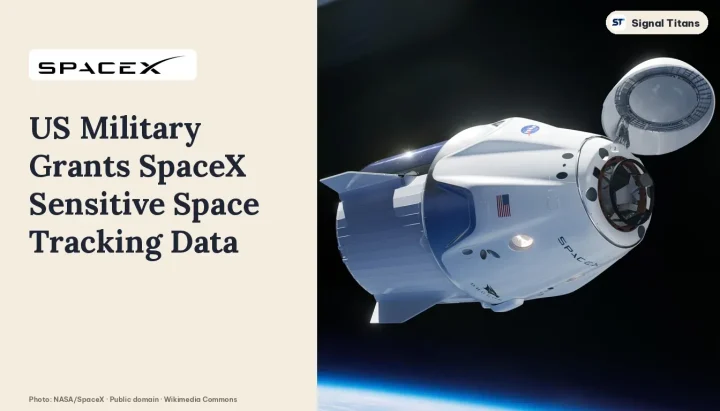
The US military has entered into an agreement granting Elon Musk’s SpaceX unprecedented access to highly restricted space tracking data, according to reports from The Guardian and Breaking Defense. Under the arrangement, the Space Force’s Joint Commercial Operations Cell has agreed to share detailed orbital information with SpaceX in exchange for telemetry from the company's Stargaze camera network. While defense officials assert the data sharing is strictly for internal operational safety, industry observers and competitors have raised urgent questions regarding national security, market fairness, and the ongoing trajectory of US space traffic management.
Inside the Data Exchange and Technical Capabilities
According to Breaking Defense and The Guardian, the agreement involves the Space Force providing SpaceX with its most precise tracking metrics, including Vector Covariance Messages derived from ground-based radars and telescopes. These messages contain detailed error margins and volumetric boundaries—known as covariances—for objects in low Earth orbit down to approximately 10 centimeters in size. Historically classified as Controlled Unclassified Information, these precise datasets were closely guarded by the military to prevent the reverse engineering of sensor capabilities.
In return, SpaceX provides the Joint Commercial Operations Cell with observations from Stargaze, a network of tens of thousands of star-tracking cameras mounted across Starlink satellites. While Stargaze struggles to detect objects smaller than half a meter, its constellation provides frequent imaging passes that help map orbital paths over time. SpaceX representatives noted at a recent industry conference that radar data remains vital for supplementing their internal tracking limitations.
Market Advantage and Industry Concerns
The unprecedented data-sharing arrangement has triggered widespread debate across the commercial aerospace sector, with many operators expressing unease about potential market distortion. Critics cited by both publications argue that granting a dominant private operator access to military-grade tracking tools creates an unfair advantage over rival companies offering similar space safety services. Government accountability advocates point out that the move aligns with broader political dynamics under the current administration, further entrenching SpaceX's formidable position in the orbital ecosystem.
Although a Space Force official emphasized that strict stipulations prohibit SpaceX from using the high-fidelity data for direct commercial gain, industry sources interviewed by Breaking Defense remain skeptical about whether the information might indirectly hone commercial analytical products. Meanwhile, former regulatory officials noted that the controversy ultimately underscores a broader governmental failure to establish a robust, publicly administered space traffic control framework.
Analysis: The Privatization of Orbit and the Future of Space Governance
This agreement marks a critical inflection point in the governance of Earth’s orbit, highlighting a deepening reliance on private infrastructure for critical public functions. For years, federal efforts to establish a civilian space traffic management system—specifically the Traffic Coordination System for Space, or Traccs—have faced severe budgetary setbacks and legislative friction under successive administrations. As federal funding for Traccs faced proposed rollbacks, commercial operators like SpaceX have aggressively stepped into the vacuum, leveraging their massive satellite constellations to manage thousands of daily conjunction maneuvers.
The decision by the Space Force to integrate SpaceX deeply into military tracking pipelines effectively cements the company as a de facto coordinator of low Earth orbit activity. While proponents argue that leveraging private telemetry improves overall orbital safety given the sheer scale of the Starlink constellation, critics warn of a dangerous vendor lock-in scenario. When a single private entity controls both the primary commercial delivery systems and the advanced tracking mechanisms required to navigate crowded skies, the boundary between public regulatory oversight and corporate monopoly blurs significantly. This dynamic not only exacerbates competitive imbalances for smaller aerospace firms but also shifts the geopolitical calculus of space safety, raising fundamental questions about accountability, transparency, and the long-term stewardship of the global commons.
Cover: NASA/SpaceX · Public domain · Wikimedia Commons. Layout and headline text by Signal Titans. Logo: SpaceX, via Wikimedia Commons (Public domain).
Source: US military gives Elon Musk’s SpaceX access to sensitive tracking data · EXCLUSIVE: SpaceX given unique access to DoD space tracking data, sources say – Breaking Defense
 SIGNAL TITANS
Leave a Reply