
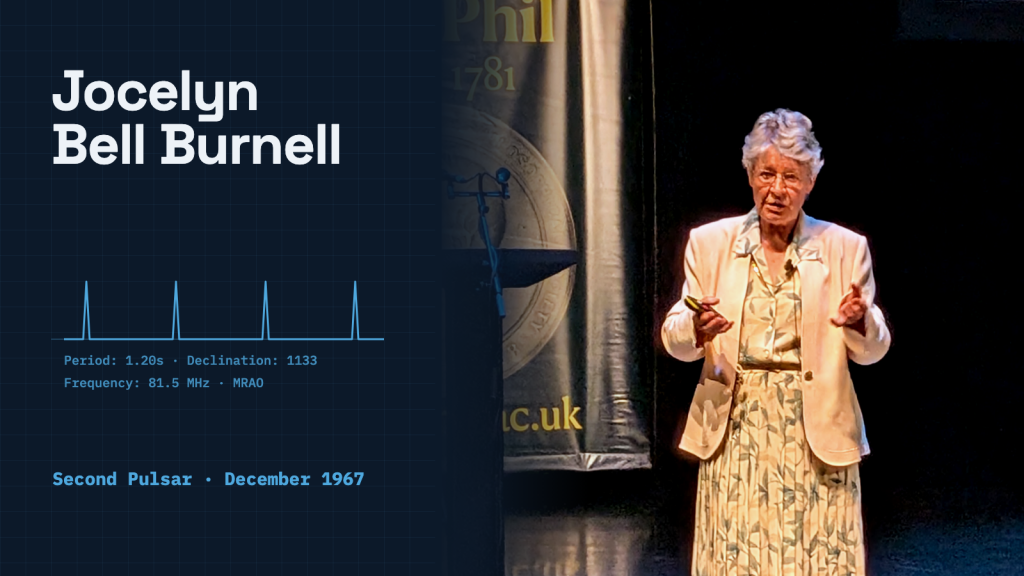
Just before Christmas in 1967, Cambridge research student S. Jocelyn Bell recorded a second source of regular radio pulses—the celestial objects now known as pulsars—weakening the possibility that the first source was an alien beacon. She had investigated unusual marks on radio telescope charts for months, resolving them into pulses about 1.33 seconds apart in late November. The second source, detected during five minutes of operation in cold weather, made two civilizations independently choosing the same frequency and time to contact Earth seem very unlikely.
Bell had arrived at Cambridge in the mid-1960s to work with radio astronomer Antony Hewish. Their goal was to detect quasars by observing interplanetary scintillation—the rapid fluctuation in radio signals caused by the turbulent solar wind. To capture these faint flickers, the team spent two years building the Interplanetary Scintillation Array at the Mullard Radio Astronomy Observatory. Covering four and a half acres, the instrument featured over 1,000 wooden posts and more than 2,000 dipole antennas connected by 120 miles of wire and cable, built by a handful of researchers for roughly £15,000.
When operations began in July 1967, the telescope produced 96 feet of three-track paper chart every day. The team initially chose visual inspection to learn the behavior of the telescope and receivers and because programming a computer to recognize different kinds of signal was difficult; Bell analyzed the charts by hand.
A Pulse in the Cold
Six or eight weeks into the sky survey, Bell noticed an occasional patch of what astronomers called “scruff” coming repeatedly from the same coordinates in the constellation Vulpecula. The signal did not look like normal scintillation, nor did it match typical man-made noise. By late November 1967, fast recordings on a high-speed pen recorder resolved the smudge into an astonishingly regular train of pulses spaced 1.33 seconds apart.
Hewish initially suspected the signal was an Earth-bound artificial transmission. But careful tracking confirmed the pulses kept strict sidereal time, arriving four minutes earlier each day in lockstep with the stars. Further tests ruled out reflections from the Moon, anomalous reflections from nearby corrugated metal buildings, and orbital satellites. Colleagues P. F. Scott and R. A. Collins detected the pulses using an independent telescope and receivers, ruling out instrumental artifacts. Soon after, John Pilkington measured the dispersion of the signal across different radio frequencies, demonstrating that it originated outside the solar system, though still within the Milky Way.
The Problem of Little Green Men
In her retrospective account published in 1977, Bell Burnell recalled that the researchers did not really believe they had detected another civilization, although they had considered the possibility. Still, they had to treat the possibility with scientific responsibility. If intelligent beings were broadcasting from a distant planet, the pulses should display Doppler shifts as the planet orbited its parent star. When Hewish conducted precise timing measurements, however, the only orbital motion detected was Earth’s own journey around the Sun.
Just before Christmas, Bell walked into a high-level discussion with Hewish about how to present the results and responsibly announce possible evidence of extraterrestrial life. The dilemma was unresolved when Bell left the meeting that evening, frustrated that speculative extraterrestrial narratives threatened to overshadow her doctoral research.
Breathing on the Receiver
Fortified by dinner, Bell returned to the laboratory late that night to clear her backlog of survey charts. Shortly before closing, while analyzing a recording of another part of the sky containing a strong signal from Cassiopeia A at lower culmination, she noticed another familiar speck of scruff at right ascension 1133. Checking earlier survey runs revealed that faint traces had appeared at those coordinates before.
The new candidate was due to transit in the early hours of the morning. Bell went out to the observatory, where cold weather caused a drastic loss of gain somewhere in the telescope-receiver system. By flicking switches and breathing on the equipment, she got it working properly for five minutes on the correct beam setting. The recording showed a second series of pulses, this time spaced 1.2 seconds apart.
The Arithmetic of Coincidence
Bell left the fresh chart recording on Hewish’s desk and departed for the Christmas holiday. In her retrospective account, Bell described leaving much happier after recording the second signal. Bell considered it very unlikely that two civilizations would independently choose the same improbable radio frequency and the same time to signal Earth. The second source in another part of the sky therefore made that explanation less plausible.
The pre-Christmas observation was an initial detection rather than instant confirmation. After returning from the Christmas holiday, Bell identified candidates 0834 and 0950. Source 1133 was confirmed roughly another fortnight later, followed soon afterward by confirmation of 0834 and 0950 as the third and fourth sources. In February 1968, the Cambridge group published their findings in Nature, announcing a new class of celestial objects.
Nature’s Lighthouse
The mystery of the pulses soon found an astronomical explanation. Fred Hoyle suggested that the sources were supernova remnants. In May 1968, Thomas Gold proposed rotating neutron stars as the origin of the pulses. These ultra-dense stellar remnants can contain more mass than the Sun in a sphere about 20 kilometers (12.5 miles) across. As these compact bodies spin, intense magnetic fields channel beams of radiation into space. Each time the beam sweeps past Earth’s line of sight, astronomers observe a sharp radio pulse, like light flashing from a cosmic lighthouse.
In 1974, Antony Hewish shared the Nobel Prize in Physics with Martin Ryle for pioneering research in radio astrophysics: Ryle was recognized for his observations and inventions, particularly aperture synthesis, and Hewish for his decisive role in discovering pulsars. Bell was omitted from the award. In her 1977 reflections, she noted that research supervisors carry the institutional risks and responsibilities of major projects. Major recognition came in September 2018, when Bell Burnell was awarded the $3 million Special Breakthrough Prize in Fundamental Physics. She chose to give the prize money to the Institute of Physics to fund doctoral scholarships for students from groups underrepresented in science.
Why the Second Signal Mattered
The team checked whether the first signal followed the stars, appeared on independent equipment, and showed the timing changes expected from an orbiting planet. Each check tested a different explanation for the pulses.
Bell then found a similar signal in another part of the sky. The second source made a natural explanation more persuasive, although it did not by itself establish what produced the pulses.
An explanation that fits one odd signal may be a fluke; one that must also fit a second, independent source faces a harder test. Bell’s second recording gave the Cambridge team exactly that.
Related stories
Sources
- S. Jocelyn Bell Burnell, “Little Green Men, White Dwarfs or Pulsars?”, Cosmic Search, Vol. 1, No. 1, 1979 (reprinted from Annals of the New York Academy of Science 302, 1977).
- Breakthrough Prize in Fundamental Physics, “Special Breakthrough Prize In Fundamental Physics Awarded To Jocelyn Bell Burnell For Discovery Of Pulsars”, September 2018.
- The Learned Society of Wales, “Jocelyn Bell Burnell”, Fellow Profile.
- The Nobel Prize, “Antony Hewish – Facts”, Nobel Media AB.
- NASA Goddard Space Flight Center, “Neutron Stars”, Imagine the Universe.
- Featured image: Victoria; Wikimedia Commons; CC BY-SA 4.0 (adapted from the original)
 SIGNAL TITANS

Leave a Reply