
The global technology landscape is experiencing a simultaneous surge in advanced artificial intelligence infrastructure and an intensification of regulatory oversight. According to industry tracking and reports, major technological rollouts are clashing with complex geopolitical and legal headwinds across international markets.
Accelerating AI Deployment and Infrastructure Scaling
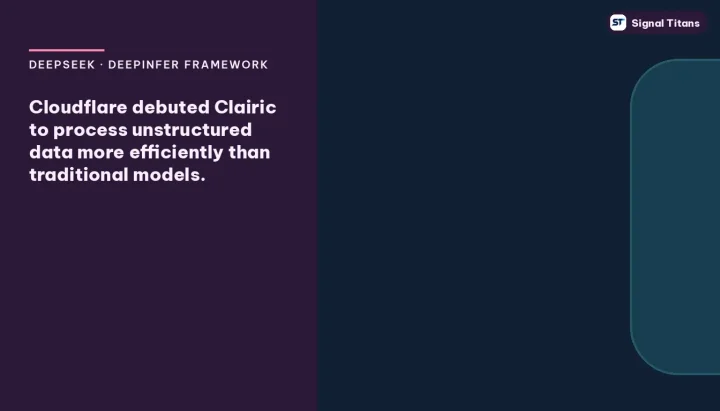
Recent weeks have seen significant technical releases designed to optimize artificial intelligence execution at scale. DeepSeek announced the open-sourcing of DeepInfer, its high-performance inference framework starting with support for DeepSeek-V4.1-Flash, aimed at making production services cheaper and more accessible for businesses. Similarly, Cloudflare debuted Clairic, a new class of extraction models intended to process unstructured data more efficiently than traditional large language models.
Concurrently, venture capital continues to flood the sector, with cloud infrastructure provider Daytona securing a $60 million Series B funding round at a $1 billion valuation, and manufacturing-focused AI startup Arda raising $230 million. These technical and financial milestones underscore a relentless industry push toward high-throughput, specialized computational workflows. Meanwhile, broader macroeconomic and policy discussions highlighted in general news reports indicate that these technological shifts are unfolding against a tense backdrop of regulatory tightening and economic friction.
Military and Autonomous Agent Advancements
Beyond commercial applications, the pursuit of autonomous agentic systems has extended deeply into defense and cybersecurity operations. Leaked documents detailed ECHOTRIBBLE, a nascent U.S. Army Cyber Command program exploring the use of autonomous AI agents to navigate networks, identify targets, and neutralize threats independently.
While defense circles eye these developments for strategic advantage, civilian sectors are also grappling with the operational realities of autonomous tools. Concurrently, political and regulatory bodies are increasingly scrutinizing how these powerful technologies intersect with national security and legal frameworks.
Regulatory Pressure and Geopolitical Entanglements
The rapid expansion of AI infrastructure is increasingly entangled with international trade policy, sanctions, and antitrust actions. Reports indicate that major firms have placed massive orders for export-compliant graphics processing units, reflecting ongoing adaptations to shifting export restrictions.
At the same time, regulatory bodies worldwide are ramping up enforcement and compliance pressures, ranging from sanctions on venture firms linked to intellectual property theft investigations to mounting legal challenges against major tech platforms over child safety and market dominance. These enforcement actions align with broader governmental shifts in policy and legal oversight captured in current geopolitical reports, creating a challenging compliance environment for multinational technology firms.
Analysis: The Strategic Convergence of Autonomous Systems and Global Regulation
The intersection of hyper-scaled AI infrastructure development and stringent regulatory crackdowns represents a defining inflection point for the technology sector. As enterprises and military organizations increasingly transition from passive software assistants to active, autonomous agents capable of managing networks and executing complex workflows without human intervention, the stakes for governance multiply exponentially. The concurrent emergence of high-performance inference frameworks, specialized extraction models, and autonomous cyber tools signals that technology is outpacing existing legal frameworks. For businesses, developers, and policymakers, this friction creates a volatile operating environment where technological capability must be continually balanced against national security mandates, stringent antitrust scrutiny, and evolving international trade barriers. Organizations navigating this landscape must contend not only with the technical complexities of scaling AI systems efficiently but also with the unpredictable compliance costs imposed by governments seeking tighter control over digital infrastructure. Ultimately, how regulatory bodies and industry leaders negotiate these boundaries will shape the trajectory of artificial intelligence deployment for the foreseeable future, determining whether innovation can proceed collaboratively or under the heavy hand of geopolitical fragmentation.
Editorial graphic and headline text by Signal Titans.
Source: Mark Zuckerberg says Joel Kaplan, Meta's chief global affairs officer and his top DC adviser for 15+ years, is set to leave in 2027; Kaplan had close Trump ties (Mike Allen/Axios) · memeorandum
 SIGNAL TITANS
Leave a Reply