
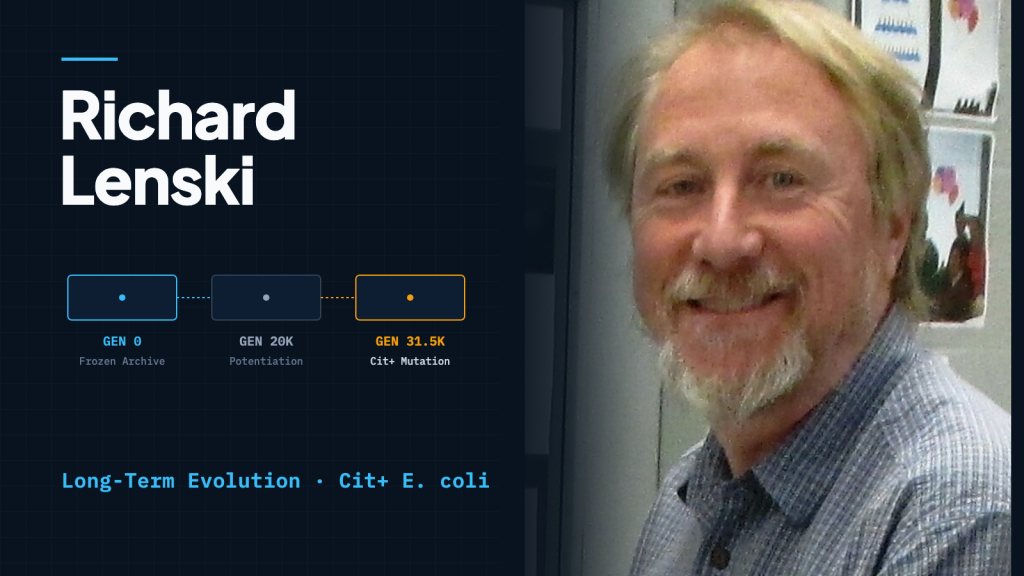
In 1988, evolutionary biologist Richard Lenski began an experiment with twelve populations of the bacterium Escherichia coli. Every 500 generations, his team froze living samples at −80°C, preserving ancestors that researchers could later revive.
Every day, including weekends and holidays, the protocol called for researchers to transfer one percent of each culture into fresh broth containing a strictly limited amount of glucose. For the frozen samples, they added a cryoprotectant to keep the cells viable.
Most paleontology relies on stone impressions left by long-dead organisms. Lenski was creating something entirely different: a living fossil record. If an unusual trait emerged thousands of days later, his team would not have to guess what their ancestral bacteria had looked like. They could open the freezer, thaw the frozen forebears, and let them grow again.
The Routine of 500 Generations
The Long-Term Evolution Experiment, or LTEE, was designed with radical simplicity. The liquid medium, called DM25, provided a low concentration of glucose—just 25 milligrams per liter, or 139 micromolar—alongside a generous abundance of citrate at 1,700 micromolar. In each daily cycle, the bacteria multiplied until the glucose was completely depleted, growing about a hundredfold in several hours before entering a stationary phase of starvation. That 100-fold expansion represented approximately 6.64 doublings, or generations, every day.
Under these constant conditions, all twelve populations initially followed a predictable trajectory. They adapted quickly to the laboratory flasks, increasing their maximum growth rates and evolving larger cells. Natural selection systematically weeded out less efficient variants. Yet across billions of individual cell divisions in each line, one fundamental barrier remained impenetrable: none of the twelve populations could consume the surrounding citrate in the presence of oxygen.
The inability to grow aerobically on citrate had long been a diagnostic characteristic of typical Escherichia coli, although citrate-positive exceptions were already known. The bacteria possessed the internal machinery of the citric acid cycle to metabolize citrate once inside the cell, and they could ferment it under anaerobic conditions if a cosubstrate supplied reducing power. What they lacked in an oxygen-rich atmosphere was a transport protein capable of pulling citrate across the cell membrane.
The Cloud in Flask Ara-3
After more than 30,000 generations, none of the twelve populations had evolved aerobic citrate use. Each population had experienced billions of mutations across a genome of approximately 4.6 million base pairs. The researchers inferred, to a first approximation, that each typical one-step mutation had been tried many times. Fitness improvement had slowed substantially across the populations.
Around generation 33,127, researchers noticed significantly elevated turbidity in population Ara-3, which continued to increase over several days. Later screening of frozen samples recovered weak citrate users from generation 31,500, when they represented approximately 0.5 percent of the population.
When the team isolated cells from this expanded population, they confirmed that the bacteria could grow aerobically using citrate as their sole carbon source, crossing a traditional diagnostic boundary for typical E. coli. Standard genetic checks proved these were not stray bacterial contaminants. They carried the exact identifying markers and specific genetic mutations that distinguished population Ara-3 from the other eleven lines.
Replaying the Tape of Life
The emergence of this citrate-using trait, designated Cit+, offered an experimental test of a longstanding scientific debate. Did the breakthrough result from an extraordinarily rare mutation that might strike at any random generation if given enough time? Or did it require a sequence of preparatory mutations that only occurred because of the unique historical path taken by population Ara-3?
Stephen Jay Gould had argued that replaying the tape of life from the distant past would yield a living world far different from our own, because evolution depends on chains of antecedent events. Simon Conway Morris had countered that natural selection channels organisms toward repeatable, constrained solutions. In most evolutionary studies, this debate remains a thought experiment because the past is gone.
Because Lenski had banked samples every 500 generations, his laboratory possessed an actual biological time machine. Researcher Zachary Blount and colleagues revived clones sampled from the ancestor through generation 32,500 of population Ara-3. They ran one replay experiment under the LTEE’s liquid-culture conditions and two others on minimal-citrate agar plates.
The results were striking. In tests examining 8.4 trillion ancestral cells and another 9 trillion cells sampled across the first 15,000 generations, not a single Cit+ mutant ever appeared. But when the team replayed evolution starting from clones frozen at generation 20,000 and later, the Cit+ phenotype re-evolved multiple times across independent cultures. The results indicated that one or more potentiating changes had arisen by generation 20,000, increasing the propensity to evolve citrate use. They did not establish that citrate use was impossible in the ancestor.
The Molecular Anatomy of a Breakthrough
Subsequent genomic sequencing revealed how the innovation occurred. The trait emerged through a tandem duplication—a repeated stretch of 2,933 base pairs of deoxyribonucleic acid (DNA). This duplication brought a copy of citT, a gene encoding a transport protein that is normally silent when oxygen is present, under the control of the aerobically active rnk promoter.
By capturing the rnk promoter, the bacteria gained the ability to produce the CitT transporter in an oxygenated flask. A single chromosomal copy of the reconstructed rnk-citT module gave a potentiated generation-32,000 clone extremely weak citrate use, with a lag exceeding 60 hours after glucose depletion. In a separate experiment using a high-copy plasmid, the module supported poor citrate growth in the ancestor but much faster, more extensive and more consistent growth in that potentiated clone. These differences demonstrated epistasis—the effect of a genetic change depended on the other genetic changes already present. The researchers could not exclude an additional contribution from changes affecting the likelihood of genomic rearrangements.
Two Subpopulations in One Flask
The Cit+ bacteria initially coexisted with a minority of evolved Cit− cells. These were contemporary lineages, rather than unchanged ancestors. Their coexistence lasted more than 10,000 generations, although the Cit− lineage later became extinct between generations 43,500 and 44,000.
Experiments mixing generation-33,000 clones showed negative frequency-dependent selection: across different starting ratios, Cit− cells approached roughly one percent of the population. These Cit− clones began growing sooner and grew faster on glucose than the Cit+ clones, supporting their persistence as glucose specialists while Cit+ cells also exploited citrate. Later, the Cit− lineage evolved improved use of succinate, malate and fumarate released by Cit+ cells.
Preparation Before the Leap
This case demonstrates how a biological innovation can depend on several stages: potentiating changes present by generation 20,000, actualization through promoter capture by generation 31,500, and subsequent refinement that improved citrate use.
Preserve the States You May Need to Test
For researchers and engineers investigating complex systems, Lenski’s archive suggests a practical principle: preserve earlier working states in a form that can be revived and tested again. Comparing outcomes alone cannot reveal which earlier changes made a later adaptation possible.
Keeping a verifiable record of past states allows direct experiments across different points in history. In Lenski’s freezer, the ancestors were always available to test what had truly changed.
Related stories
Sources
- Introduction to the Long-Term Evolution Experiment — Richard E. Lenski, The LTEE Project
- Historical contingency and the evolution of a key innovation in an experimental population of Escherichia coli — Zachary D. Blount, Christina Z. Borland, Richard E. Lenski (PNAS 2008)
- Genomic analysis of a key innovation in an experimental Escherichia coli population — Zachary D. Blount, Jeffrey E. Barrick, Carla J. Davidson, Richard E. Lenski (Nature 2012)
- Dynamics of adaptation and diversification: a 10,000-generation experiment with bacterial populations — Richard E. Lenski, Michael Travisano (PNAS 1994)
- Revisiting the Design of the Long-Term Evolution Experiment with Escherichia coli — Richard E. Lenski (Journal of Molecular Evolution 2023)
- Featured image: Zachary Blount / crop by Ras67 / Wikimedia Commons / CC BY-SA 4.0. https://commons.wikimedia.org/wiki/File:Richard_Lenski_in_2016.jpg ; https://creativecommons.org/licenses/by-sa/4.0
 SIGNAL TITANS

Leave a Reply