
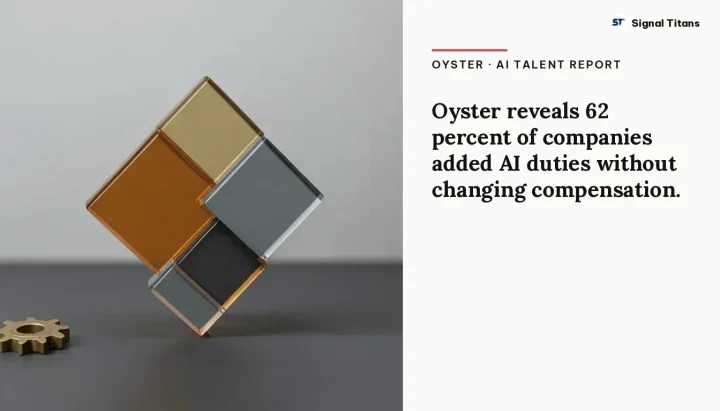
According to Oyster’s 2026 Global AI Talent Report, workplace adoption of artificial intelligence is creating a notable friction point between employers and staff, as daily responsibilities evolve faster than official job descriptions. Analyzing data from over 15,000 job descriptions alongside surveys of more than 1,000 HR professionals, the research highlights that AI requirements appeared in 15 percent of roles filled through Oyster’s platform during the first half of 2026, a significant increase from just 5 percent in 2022. Concurrently, commercial platforms providing employer-of-record services, such as Oyster's global compliance and payroll infrastructure operating across over 120 countries, report growing demand for international recruitment to bridge talent gaps. However, this fast-paced integration of technology frequently occurs in informal ways, raising fundamental questions about how organizations evaluate, compensate, and define modern workloads.
Expanding AI Expectations in Everyday Roles
The platform analysis conducted for the report indicates that expectations for artificial intelligence proficiency are no longer restricted to specialized technical departments. While engineering roles maintained a high demand with 23 percent requiring AI skills between 2025 and June 2026, non-technical positions saw substantial inclusion as well. Specifically, marketing coordinator roles showed AI requirements in 17 percent of listings, recruiter listings reached 15 percent, and operations coordinator roles stood at 10 percent. These shifts demonstrate that everyday administrative and creative positions are steadily being rewritten around AI assistance. Rather than establishing entirely new job titles, organizations are frequently embedding these advanced expectations into familiar occupations, requiring workers to exercise judgment regarding automated outputs while maintaining human accountability for final results.
The Disconnect in Communication and Compensation
Despite these expanding duties, the survey findings suggest a widespread management gap regarding formal recognition and communication. Among respondents whose companies introduced AI requirements to existing roles over the preceding year, 62 percent noted that neither job titles nor compensation packages were modified. Furthermore, 46 percent of respondents in companies adding these expectations to traditionally nontechnical roles reported that the new duties were never formally communicated to employees. Hiring processes also display inconsistencies, with 53 percent of surveyed professionals indicating that candidate answers regarding personal AI projects do not ultimately influence hiring or compensation decisions. These figures illustrate that while managers increasingly expect AI fluency, many enterprises struggle to translate those informal expectations into structured employment terms.
Why Workplace Disconnects Pose Strategic Risks for Organizations
The widening gap between unspoken workplace expectations and formal job definitions carries profound implications for employee retention, legal compliance, and organizational productivity. When employers quietly expand daily responsibilities to include artificial intelligence workflows without corresponding adjustments to compensation, titles, or explicit guidelines, they risk creating hidden burnout and eroding trust among staff. For workers, an unmeasured increase in workload makes it difficult to distinguish between standard performance and unreasonable demands, while managers struggle to evaluate productivity accurately. At the same time, companies navigating these shifts while managing global teams via employer-of-record providers face additional administrative hurdles, such as ensuring correct worker classification and compliance with local labor laws across diverse international jurisdictions. Ultimately, the report underscores that integrating artificial intelligence requires more than simply adopting advanced tools or screening candidates with generic questions; it demands a deliberate alignment between daily operational tasks, transparent communication, and structured evaluation frameworks to ensure sustainable workforce growth.
Infrastructure and International Talent Strategies
To address local talent shortages, organizations are increasingly looking beyond domestic borders, a strategy supported by modern employer-of-record platforms that streamline cross-border hiring without requiring companies to establish foreign corporate entities. Among survey respondents prioritizing external AI hiring, 34 percent stated they recruited internationally due to domestic shortages, compared to 18 percent among those prioritizing internal training. Furthermore, platform statistics indicate regional variations in AI-required roles, showing 21 percent in Switzerland, 20 percent in Poland, 19 percent in Portugal, and 17 percent in Romania. While these figures reflect platform-specific activity rather than total national talent pools, they illustrate how borderless employment infrastructure helps enterprises source specialized skills, provided they maintain rigorous compliance and correct worker classification under local legal frameworks.
Cover: AI-generated illustration with headline text; not a documentary photograph.
Source: Oyster’s 2026 Global AI Talent Report Finds AI Skills Are Outpacing Job Definitions · Employer of Record (EOR) Services | Oyster®
 SIGNAL TITANS
Leave a Reply