
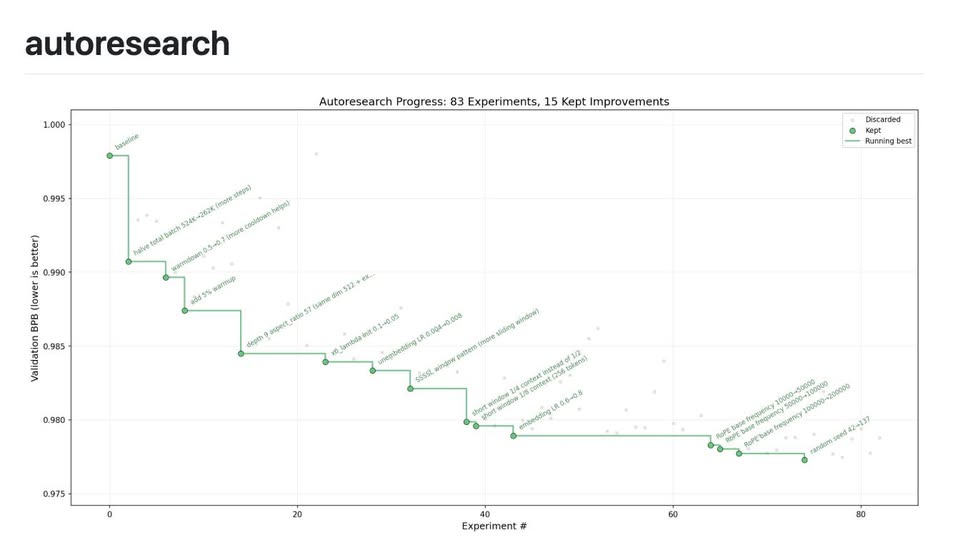
Karpathy just open-sourced one of the smallest autonomous self-improving training systems — and it’s already going viral in the AI community.
Instead of waiting for frontier models like Claude or Codex to improve, many developers are starting to train their own agents. Here are 16 reasons why this approach is becoming increasingly compelling.
⸻
1. Domain Mastery
A trained agent focused on a specific domain can outperform general LLMs by mastering skills that broad models can never fully specialize in.
2. Self-Improving Reasoning
Agents can improve over time through training during usage, gradually enhancing their reasoning abilities in specific contexts.
3. Full Model Control
You control updates and improvements instead of relying on a company’s roadmap or dealing with sudden model behavior changes.
4. Leaner and More Cost-Efficient
A specialized model often costs a fraction compared to repeatedly calling frontier APIs for every inference.
5. Fewer Hallucinations
High-quality domain datasets ground the model in facts, significantly improving accuracy.
6. Goal-Aligned Growth
Your agent evolves around your actual goals, not generic benchmarks that may not matter to your work.
7. Data Privacy
Sensitive code, internal documents, and proprietary datasets stay inside your infrastructure.
8. Compound Advantage
Each improvement builds on the previous one, creating a long-term knowledge moat that API users can’t easily replicate.
⸻
9. Offline & Air-Gapped Operation
Agents can run in fully secure environments without internet connectivity — critical for defense, healthcare, and regulated industries.
10. Faster Inference Latency
Small local models can respond in milliseconds without network round-trips to remote APIs.
11. Custom Personality & Tone
You can bake brand voice, communication style, and formatting rules directly into the model weights.
12. Proprietary Data Advantage
Training on internal logs, tickets, and interactions turns your private data into a competitive advantage.
13. Regulatory Compliance
Maintaining clear training records and audit trails makes it easier to meet standards like GDPR, HIPAA, or SOC2.
14. Avoid Capability Deprecation
When providers change or retire models, your system keeps working because you own the weights.
15. Multi-Agent Specialization
You can build a swarm of specialized micro-agents, each trained for a specific task.
16. True Ownership
Your intelligence layer becomes an asset on your balance sheet, not a recurring subscription dependency.
⸻
The Real Sweet Spot: A Hybrid Approach
The future likely lies in combining both worlds:
• Use frontier models for heavy reasoning
• Train specialized agents for the tasks that matter most
In the end, AI systems may evolve into an orchestrated intelligence layer, where different models collaborate — each doing what it does best.
Read more and join the conversation on Facebook.
 SIGNAL TITANS
Leave a Reply