

Grace Hopper’s influence reaches beyond any single program or machine. Through her work on early compilers and her role in shaping COBOL, she helped advance a consequential idea: programming languages could be designed around the needs of people, not only the internal operations of computers.
From Mathematics to Wartime Computing
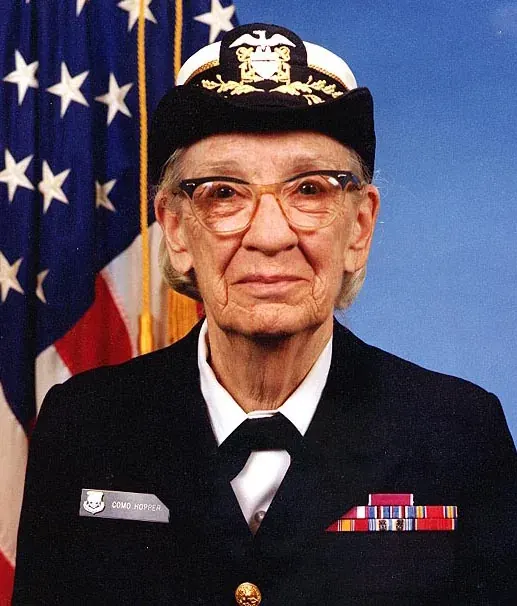
Born in New York City in 1906, Hopper studied mathematics and physics at Vassar College before earning a master’s degree and a doctorate in mathematics from Yale University. She taught at Vassar from 1931 until 1943, when she joined the US Navy Reserve during the Second World War.
Her first Navy assignment brought her to the Harvard Computation Laboratory, where she worked with Professor Howard Aiken on problems of military significance. This placed her inside a young field in which large computing machines were beginning to demonstrate their practical value, while programming remained closely tied to the machinery itself.
Building a Bridge to the Machine
Hopper remained at Harvard until 1949 and then joined the Eckert-Mauchly Computer Corporation, led by the designers of ENIAC. There she developed one of the world’s first compilers and worked on compiler-based programming languages. A compiler translates instructions written in a programming language into a form a computer can execute, allowing programmers to work at a more understandable level of expression.
The importance of this work was not limited to convenience. It helped redefine the intended audience for computing. If instructions could be expressed through languages closer to human purposes, computers could become useful to people solving organizational and commercial problems without requiring every task to be framed in machine-oriented terms.
A Language for Business
In 1959, Hopper played an important role in defining a new, easier-to-use programming language. The result was COBOL, which became one of history’s most successful languages for business applications. Its development reflected the broader direction of her work: powerful systems became more useful when their complexity could be translated into forms suited to the people applying them.
Hopper also became known for humorous lectures about computer science and received extensive recognition, including the US National Medal of Technology in 1991. She retired from the Navy Reserve in 1986 with the rank of Rear Admiral, then worked as a senior consultant for Digital Equipment Corporation until her death in 1992.
The Enduring Lesson
Hopper’s career offers an editorial lesson rather than a universal formula: accessibility can be a form of technical ambition. Creating an interface between human intentions and machine operations does not diminish computing power; it can broaden where that power is applied. Her legacy rests partly in helping programming evolve from an activity organized around machines into one increasingly organized around the problems people wanted machines to solve.
Cover: AI-generated editorial illustration; not a documentary photograph.
Source: Grace Hopper and making computers understand people
 SIGNAL TITANS
Leave a Reply