
Traditional AI memory evaluations have long focused on static fact recall, leaving a critical gap in whether an agent can actually apply past experiences to improve future performance. To address this limitation, Letta announced the release of FrontierMemory 1.0, a new benchmarking suite designed to measure continual learning in language model agents. According to project disclosures and independent technical reports, the benchmark shifts away from simple trivia and lookups by adapting established coding and knowledge-work tasks into stateful scenarios that require memory derived from historical execution traces.
Evaluating Harnesses and Infrastructure
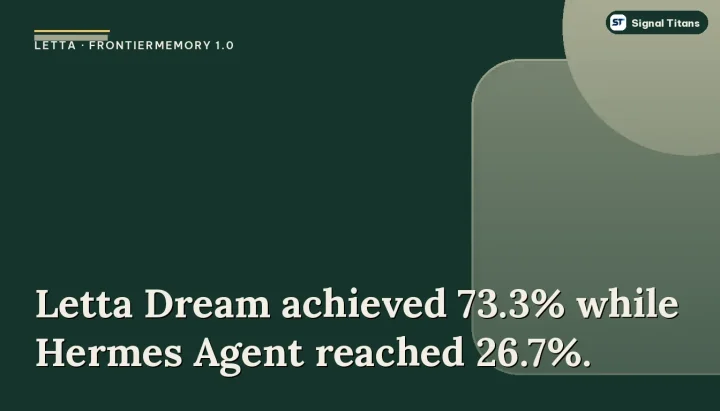
The choice of agent harness—the underlying software infrastructure managing execution—proves just as critical as the foundational model itself. Early evaluations across five distinct agent systems demonstrated stark performance disparities. Letta Dream achieved the highest mark at 73.3%, followed by Prime Agent at 60%. Meanwhile, the OpenAI Agents SDK recorded 40%, while Claude Managed Agents and Hermes Agent reached 33.3% and 26.7%, respectively. Developers note that these discrepancies stem from how each infrastructure handles the process where an agent reviews past trajectories to extract reusable instructions and skills. However, researchers caution that without proper oversight, unverified memory updates risk reinforcing bad operational habits.
Model Memory Generation and Economics
Beyond the harness, FrontierMemory 1.0 evaluated seven frontier models on their ability to generate effective memory assets. Anthropic’s Claude Opus 5.5 and Z.ai’s GLM-5.3 shared the top tier with matching scores of 73.3%, outperforming offerings like Kimi K3 at 66.7%, GPT-6.1 Sol and Gemini 4 Argon at 60%, and Grok 4.7 at 33.3%. While top-performing models excelled at crafting generalizable instructions—such as Opus 5.5 creating robust conditional rules—cheaper alternatives presented significant economic advantages. Running GPT-6.1 Sol cost an estimated $0.77 per task, compared to $2.80 for Opus 5.5 and $3.58 for GLM-5.3, illustrating a distinct compromise between raw memory quality and operational expenditure.
Why Continual Learning Metrics Matter
The introduction of FrontierMemory 1.0 marks a vital maturation point for autonomous software engineering, shifting the industry's focus from superficial trivia tests to genuine longitudinal adaptation. Most legacy benchmarks evaluate agents under artificial, stateless conditions where all necessary context is handed to the system upfront—resembling a brand-new hire who requires explicit directions for every micro-task. By requiring agents to synthesize their own instructions from past successes and failures, FrontierMemory simulates the accumulated intuition of a senior employee. The findings highlight a transformative architectural strategy for developers: teams can leverage expensive, highly capable models like Claude Opus 5.5 to synthesize generalized skills and memories offline, while deploying more cost-effective execution engines to handle downstream tasks. This decoupled workflow mitigates high operational overheads without sacrificing contextual intelligence. Furthermore, qualitative observations reveal that memory structure directly dictates execution success; overfitted rules tied to superficial artifacts like file sizes consistently fail, whereas imperative procedural instructions generalize across changing environments. As multi-agent multiplayer frameworks and online memory updates emerge in future iterations, these insights will fundamentally reshape how engineering teams design persistent, self-improving agent ecosystems.
Editorial graphic and headline text by Signal Titans.
Source: Five AI agent harnesses took the same memory test. The results weren’t even close. · FrontierMemory 1.0 | FrontierMemory
 SIGNAL TITANS
Leave a Reply