
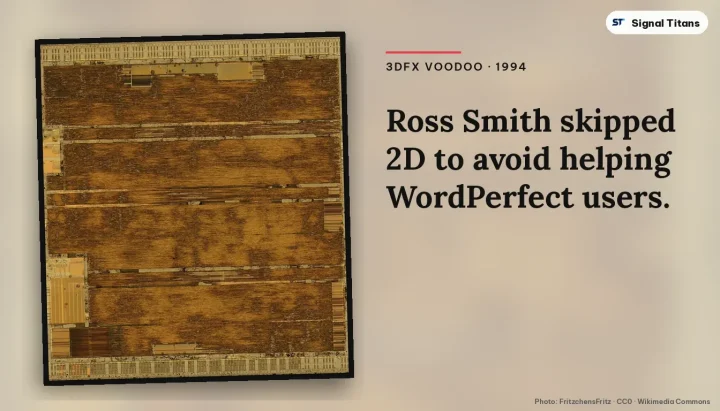
Marking three decades since the emergence of the 3dfx Voodoo graphics chipset, historical retrospectives from cofounder Ross Smith shed light on the turbulent and visionary beginnings of PC 3D acceleration. According to interviews published by PC Gamer and Club386, Smith, alongside fellow founders Scott Sellers and Gary Tarolli, transitioned from Silicon Graphics and the defunct startup Pellucid to target the nascent home PC gaming market in 1994. While early skepticism plagued the team—with industry heavyweights initially dismissing their concepts—the architecture they built fundamentally reshaped interactive entertainment on personal computers.
Bypassing 2D Compatibility for Pure Gaming Focus
When 3dfx introduced its hardware, the decision to omit an onboard 2D VGA controller stunned contemporaries. Club386 reports that Diamond Multimedia executives questioned the viability of a card requiring an external 2D VGA adapter linked via a physical analogue pass-through cable. Smith explained that this unorthodox design stemmed partly from a lack of design experience with standard VGA systems and partly from a deliberate strategy to sidestep the immense support burden required for general-purpose software like WordPerfect or Excel. By restricting compatibility to a targeted roster of games rather than a million Windows applications, the company maintained commercial focus and profitability, eventually winning over partners like Orchid Technology, Guillemot, and Diamond.
The 'Quake Effect' and the Rise of MiniGL
The hardware's trajectory changed dramatically following the release of id Software’s Quake in mid-1996. While the title initially debuted without 3D hardware acceleration, John Carmack reportedly contacted 3dfx to establish hardware support, prompting the creation of the MiniGL API that enabled GLQuake by early 1997. According to PC Gamer, Smith credits id Software and Quake with driving millions of Voodoo board sales. Unlike competitors who allegedly viewed game developers as a peripheral concern, 3dfx actively courted studios by showcasing pre-rendered scenes on Voodoo hardware, ensuring early 3D titles pushed graphical boundaries far beyond contemporary console limitations.
Why This Matters: The Legacy of a Developer-Centric Hardware Model
The historical account of 3dfx’s rise offers profound insight into the symbiotic relationship between hardware manufacturers and software developers that defines the modern GPU industry. As detailed across reports from PC Gamer and Club386, 3dfx broke convention by treating game studios not as a necessary operational hurdle, but as the primary lifeblood of hardware adoption. This philosophy directly prefigures modern ecosystem strategies employed by contemporary giants like Nvidia, AMD, and Intel, who maintain deep engineering partnerships with game developers to optimize titles on launch day. Furthermore, 3dfx’s hardware-software co-development paved the way for dedicated graphics processing units that unburdened the central processor. Although 3dfx ultimately folded and its assets were acquired by rival Nvidia following patent disputes in the early 2000s, the architectural discipline and developer-focused ethos pioneered by Smith, Sellers, and Tarolli established the structural blueprint for decades of subsequent graphics card evolution. Understanding this foundational era illuminates how specialized hardware architectures achieve market dominance not merely through raw compute performance, but through early alignment with visionary software creators.
Cover: FritzchensFritz · CC0 · Wikimedia Commons. Layout and headline text by Signal Titans.
Source: 'We probably sold millions of boards because of that game, and it was magnificent': 3dfx cofounder gives Quake a 'great deal of credit for our overall success' · The 3dfx Voodoo story: as the legendary graphics card tech turns 30, we talk to cofounder Ross Smith | Club386
 SIGNAL TITANS
Leave a Reply