
Governments and organizations worldwide have scrambled to take critical web services offline following the disclosure of two severe security vulnerabilities in PHP, the programming language powering a vast majority of the internet. According to reports from BetaKit and Decrypt, officials in Canada, Finland, France, and the Netherlands have temporarily disabled public-facing government websites as a precaution against potential remote code execution attacks. The emergency measures follow urgent warnings from cyber security agencies and the rapid deployment of patches by the PHP security team.
Technical Scope and Vulnerability Mechanics
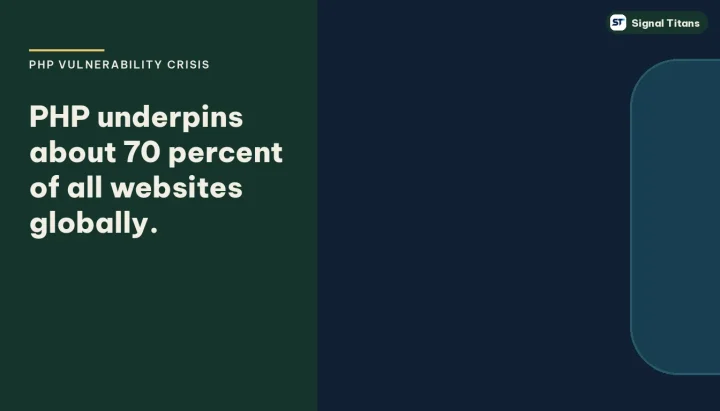
The security flaws, designated as CVE-2026-109618 and CVE-2026-109619 and both rated 9.2 out of 10 on the Common Vulnerability Scoring System (CVSS), allow unauthenticated remote code execution on affected servers. Decrypt notes that the first bug arises when PHP mishandles memory exhaustion during request handling, while the second involves lingering data from previous user sessions that subsequent requests can accidentally access. These weaknesses permit unauthorized attackers to run arbitrary commands, potentially leading to total server takeover, data theft, or site defacement. W3Techs data cited across both reports indicates that PHP underpins roughly 70 percent of all websites with known server-side languages, ranging from content management systems like WordPress to e-commerce engines like Adobe Magento.
International Shutdowns and Emergency Patches
As early exploits began to emerge and details leaked prematurely on forums like Hacker News, major platform operators and national cybersecurity bodies moved swiftly. BetaKit reported that Canadian AI and Digital Innovation Minister Evan Solomon announced temporary website shutdowns to protect government systems, guided by the Canadian Centre for Cyber Security. Meanwhile, Decrypt outlined broader international actions, including state IT centers in Finland, Dutch cybersecurity agencies, and the French Interior Ministry unplugging public web services. Infrastructure providers like Cloudflare deployed emergency firewall rules hours before official patches arrived, while security researchers noted that AI tools, including OpenAI’s GPT-5.6 Sol model, played a role in identifying the underlying flaws.
Understanding the Systemic Fragility of Open-Source Infrastructure
This sudden global panic highlights the immense systemic risk tied to foundational, open-source software projects that quietly support the modern digital economy. Because PHP handles server-side logic for an overwhelming percentage of global web traffic, a zero-day vulnerability in its core memory management instantly exposes millions of disparate systems, from local government portals to enterprise e-commerce platforms. The crisis also underscores a shifting paradigm in cybersecurity: the accelerating weaponization of frontier artificial intelligence models, such as OpenAI’s GPT-5.6 Sol, to uncover complex code vulnerabilities faster than traditional human audit cycles. While the PHP Foundation acted quickly to ship emergency patches for supported versions—specifically releasing versions 8.5.12, 8.4.27, 8.3.36, and 8.2.35—the sheer volume of legacy installations running older, unsupported code creates a persistent security backlog. Organizations relying on outdated infrastructure face difficult choices between maintaining public availability and isolating internet-facing systems entirely, illuminating the ongoing tension between rapid digital deployment and foundational software resilience.
Editorial graphic and headline text by Signal Titans.
Source: Canadian government shuts down some websites amid global cybersecurity scare · PHP Panic: Two Critical Bugs Put 70% of the Internet at Risk, and Everyone Is Freaking Out – Decrypt
 SIGNAL TITANS
Leave a Reply