
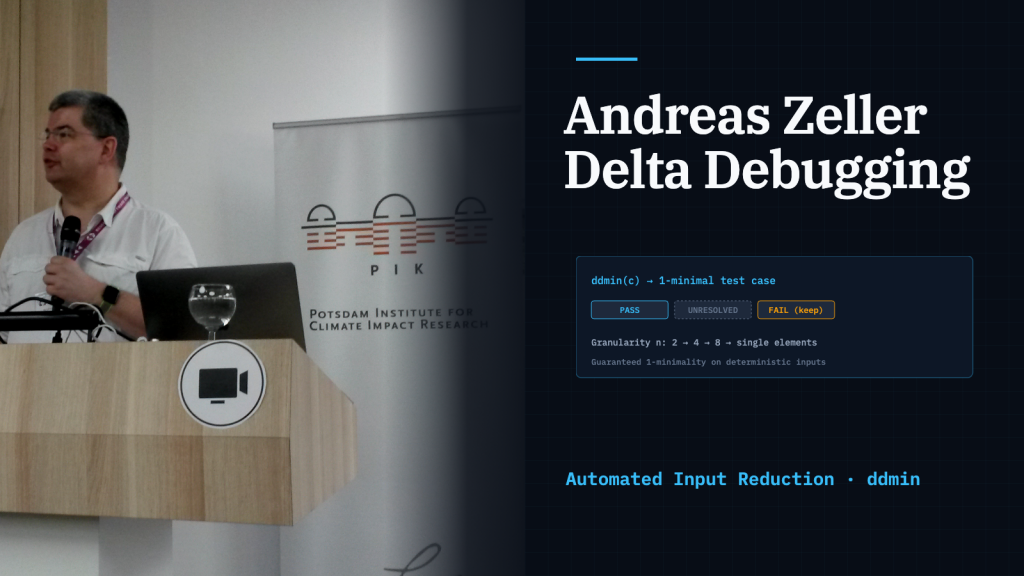
In 1999, Andreas Zeller introduced Delta Debugging to isolate the code changes that break working software. In a 2002 paper, Zeller and Ralf Hildebrandt tackled a related question: how much of a failing input could a program lose and still fail?
When an automated testing tool or a user report uncovers a crash, the triggering input is often thousands of lines of text, code, or data filled with irrelevant noise. Manual reduction involves deleting parts of an input and rerunning tests to see whether the failure persists. The ddmin algorithm automates that reduction. With deterministic test outcomes, a failing starting input, a passing empty baseline, and enough time to finish, it guarantees 1-minimality relative to the chosen input elements.
The Divide-and-Conquer Search for Failure
In 1999, Brian Kernighan and Rob Pike described a manual debugging strategy in their book The Practice of Programming: when an input causes a program to fail, throw away half the input and see if the output is still wrong; if it is not, restore the previous input and discard the other half. This divide-and-conquer binary search works well when a single isolated section holds the defect.
Simple binary search can stall when neither half reproduces the failure. A crash might depend on interactions between two separate parameters, or removing half an input might break its syntax before the program reaches the faulty code. Zeller and Hildebrandt’s 2002 ddmin algorithm extended binary search by trying smaller chunks when neither half reproduces the failure, although syntax constraints can still prevent useful reduction.
How ddmin Systematically Discards Input
The original ddmin algorithm divides the current input into n approximately equal parts, starting with n = 2. It first tests the parts themselves. If a part reproduces the target failure, it continues with that part and resets n to 2. Otherwise, it tests complements—the current input with one part removed. If a complement reproduces the failure, it keeps that complement and sets n to the larger of n − 1 and 2.
If neither a part nor a complement reproduces the failure, ddmin doubles n, capped at the number of remaining input elements. It stops when no reduction succeeds at single-element granularity. The user chooses what counts as an element, such as lines, tokens, or characters; ddmin does not automatically change from one kind of element to another. The cited books also show a simpler implementation that tests only complements.
Why 1-Minimal Does Not Mean the Shortest Input
Delta debugging’s 1-minimal result need not be the globally shortest failing subset of the original input. Without assumptions that allow candidates to be ruled out, searching for a global minimum using only test outcomes can require exponentially many tests: an input with m elements has 2m subsets.
On completion under those conditions, ddmin guarantees 1-minimality relative to the chosen input elements: the result still fails, but deleting any one element produces a passing or unresolved outcome. This does not prove that every retained element causes the bug; some deletions may simply make the test inconclusive. Removing two or more elements together may still yield a smaller failing subset of the same result.
Handling the Unresolved State
Automated reduction requires a dependable test oracle that returns one of three outcomes: pass, fail, or unresolved. The oracle—the rule that classifies a test’s result—reports failure when the specified failure occurs, success when the test succeeds, and an unresolved outcome when it cannot determine the result. The target failure can be an incorrect result or a violated assertion as well as an exception or crash.
The third outcome—unresolved—is crucial. If removing a chunk produces an unparseable file, a syntax error, or an unrelated crash, the test cannot determine whether the original bug is still present. The ddmin algorithm treats an unresolved result as an unsuccessful reduction attempt: it accepts a smaller candidate only when that candidate reproduces the target failure.
From Academic Theory to Compiler Infrastructure
In 2009, the Association for Computing Machinery’s Special Interest Group on Software Engineering (ACM SIGSOFT) awarded Zeller the Impact Paper Award for his foundational 1999 work.
Compiler developers apply delta debugging concepts to triage defects. The LLVM compiler infrastructure includes llvm-reduce, a dedicated automated tool that applies delta passes across Intermediate Representation (IR) files to shrink large test cases that crash the optimizer. Automated reduction can make failing test cases easier for developers to understand and communicate.
By treating debugging as an experimental search problem, Zeller showed that finding the essence of a bug does not require guessing intent; it requires systematically testing what the input can afford to lose.
Related stories
Sources
- Isolating Failure-Inducing Changes — Andreas Zeller, The Debugging Book
- Reducing Failure-Inducing Inputs — Andreas Zeller, The Debugging Book
- ACM SIGSOFT Impact Paper Award — ACM SIGSOFT
- llvm-reduce – LLVM automatic testcase reducer — LLVM Project
- Reducing Failure-Inducing Inputs — Andreas Zeller, The Fuzzing Book
- Featured image: Stefan Weil; Wikimedia Commons; CC BY 4.0 (adapted from the original)
 SIGNAL TITANS

Leave a Reply