
Apple has officially introduced the HomeView, marking the company’s first foray into the smart display market, according to reports from Cult of Mac and WIRED. Positioned as a communal household hub, the device is scheduled to launch on November 13 with a retail price of $299 for both the tabletop model and the wall-mounted variant. Preorders are currently open, though regional availability is restricted; Cult of Mac notes that the device will not be sold in the European Union due to regulatory and availability constraints surrounding Siri AI features.
Design, Hardware, and Multi-User Support
Built around a 7-inch square screen, the HomeView physically resembles a scaled-up Apple Watch, complete with customizable watch-style faces and widgets, as described by WIRED. Powered by Apple’s A18 chip, the aluminum-framed hardware comes in finishes including silver, starlight, rose pink, and space gray. The standard tabletop model features a metal base housing a down-firing woofer and passive radiators for room-filling sound, while the wall-mounted version adapts its audio tuning for surface placement. Both configurations integrate a 12-megapixel Center Stage camera and a four-microphone array.
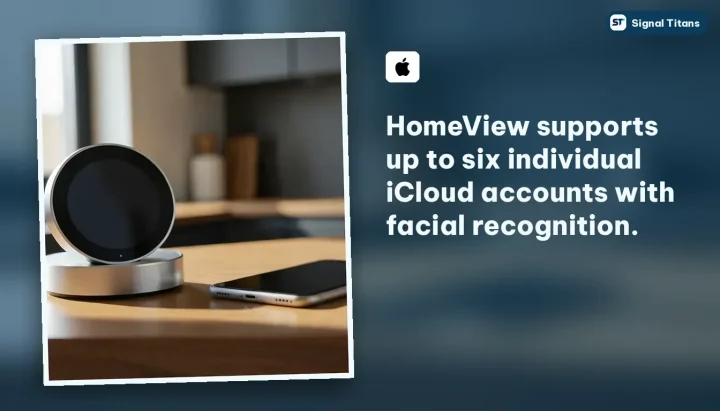
To accommodate shared household environments, the device supports up to six individual iCloud accounts. According to the reports, the interface dynamically shifts based on facial and voice recognition, ensuring that users see only their personalized home screens, custom complications, and messages when standing before the display. WIRED adds that unlocking this personal context requires a connected iPhone on the same Wi-Fi network.
Curated Software and the Absence of an App Store
A defining characteristic of the HomeView's operating system is the complete lack of a dedicated App Store. Instead, the device ships with 15 built-in applications, encompassing communication tools like FaceTime, Messages, and Intercom alongside productivity staples such as Calendar, Reminders, Find My, and the Home app. Web browsing is handled by Safari, while audio needs are met by Apple Music and Podcasts, supplemented by utilities like Alarms, Timers, Weather, World Clock, and Settings.
Because users cannot download standalone applications directly onto the hub, the system relies heavily on a synchronized iPhone running iOS 27.2 or later (or an iPad with iPadOS 27.2). Additional first-party applications like Audiobooks, Classical Music, News, and TV are pulled directly from the phone. Furthermore, third-party media integration is achieved through Apple's CarPlay framework. As WIRED and Cult of Mac explain, developers can bring existing CarPlay-compatible media apps, such as Spotify, onto the HomeView automatically if they are already installed on the paired iPhone. Video streaming services like YouTube or Netflix are currently absent, leaving the Safari browser as the sole workaround for web video playback.
Why This Matters: Navigating a Crowded Smart Home Market
Apple’s entry into the smart home display category places it in direct competition with entrenched rivals like Google and Amazon, which have dominated the space for a decade. The analysis of this release centers on whether Apple's tightly integrated ecosystem approach can compensate for its late arrival and hardware constraints. By tethering core capabilities so closely to the iPhone—and restricting advanced contextual features to devices equipped with Apple Intelligence, such as the iPhone 15 Pro or newer—Apple is attempting to leverage its existing user base rather than building an open platform. This strategy carries distinct trade-offs. On one hand, relying on localized facial recognition and on-device data processing aligns with growing consumer demand for digital privacy, a strength emphasized by Counterpoint analyst Anshika Jain regarding trust in smart home hardware. On the other hand, the absence of an App Store and the complete dependence on a local iPhone introduce friction for multi-device households or users embedded in mixed-ecosystem environments. Ultimately, the HomeView's success will not merely depend on its polished brushed-metal aesthetics or its novel watch-inspired interface; it hinges on the reliability of Siri AI to execute complex, everyday natural-language interactions seamlessly. If the revamped voice assistant falters in practical application, Apple’s premium smart hub risks becoming an expensive, highly restricted digital photo frame rather than the functional hearth of the modern connected home.
Cover: AI-generated illustration with headline text; not a documentary photograph. Logo: Apple, via Wikimedia Commons (Public domain).
Source: Apple HomeView apps include 15 built-ins — but no App Store · The Apple HomeView Is Like a Giant Apple Watch for the Home | WIRED
 SIGNAL TITANS
Leave a Reply