
In April 1964, technicians installed a real-time computer complex inside Building 30 at the newly established Manned Spacecraft Center in Houston, creating the central processing core for American human spaceflight. Construction on Building 30 had begun in late 1962 and concluded in November 1964. According to NASA, the original three-story facility featured an administration wing for offices and conference rooms, a lobby wing, and a mission operations wing built around two distinct Mission Operations Control Rooms (MOCRs). In June 1964, employees moved from temporary offices in southeast Houston's Stahl and Myers and Houston Petroleum Center buildings to test the new hardware on site.

Laying the Concrete for Dual Control
Before the Houston facility became operational, early Mercury and Gemini flights were monitored from Cape Kennedy in Florida using flight control principles developed by NASA flight director Christopher C. Kraft. As missions grew longer and more complex, NASA required a centralized command structure with expanded computing capacity and technical flexibility. Building 30 was designed with two main control rooms so that controllers could manage active flights in one room while configuring hardware for future missions in the other.
The Transfer of Primary Flight Operations
By January 1965, flight controllers in Building 30 monitored data during the uncrewed Gemini 2 test flight, though primary command stayed at Cape Kennedy. During the crewed Gemini 3 flight on March 23, 1965, the Houston facility served as a backup control room. On April 9, 1965, George E. Mueller, NASA’s Associate Administrator for Manned Space Flight, announced that primary flight control for human space missions would officially transfer from Cape Kennedy to Houston. That transition occurred in June 1965 during Gemini IV, the first crewed mission directed from Houston, led by Kraft alongside flight directors Eugene F. Kranz and John D. Hodge.
Dividing the Lunar and Orbital Missions
With two operational control rooms in the mission operations wing, engineers divided operational assignments between active spaceflights and upcoming vehicle tests. Following Gemini IV, the remaining eight Gemini flights were controlled from the third-floor control room, while the second-floor room monitored uncrewed Apollo test flights in 1966. During the Apollo 11 lunar landing mission in July 1969, controllers managed operations from the third-floor room, designated MOCR-2. Following Apollo 11, NASA deactivated the second-floor MOCR-1 until October 1971, when it was reactivated to support Skylab and the joint Apollo-Soyuz Test Project, while MOCR-2 stood down in May 1973.
Upgrades and the Five-Story Expansion
As NASA transitioned into the Space Shuttle program, Building 30 underwent systematic hardware upgrades. In December 1989, technicians replaced older displays in the main control rooms with glass display screens and image projectors. To support continuous orbital operations, NASA constructed a five-story Station Operations Wing on the facility. A control facility inside this addition, designated the White Flight Control Room (FCR), assumed sole operational control of shuttle missions starting with STS-77 in May 1996.
A Monument to Operational Architecture
The structural design of Building 30 remains central to NASA's human spaceflight infrastructure. In October 1985, the U.S. Department of the Interior designated MOCR-2 a National Historic Landmark. On April 4, 2011, NASA officially renamed Building 30 the Christopher C. Kraft, Jr. Mission Control Center, preserving its historical footprint while its White FCR continues to conduct simulations for Artemis lunar operations.
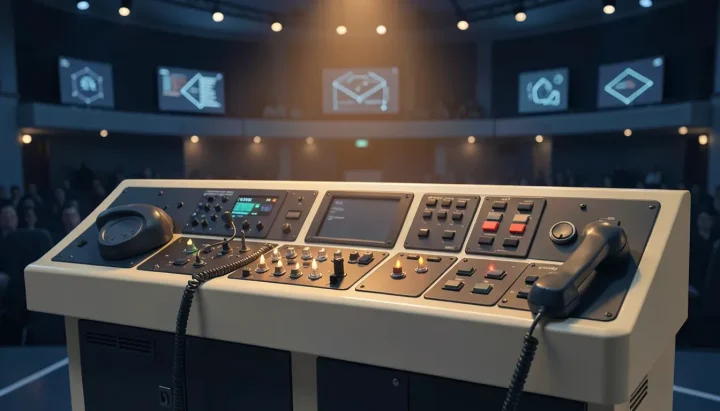
Cover: AI-generated editorial illustration; not a documentary photograph.
Source: Building on a Mission: The Houston Mission Control Center
 SIGNAL TITANS
Leave a Reply