
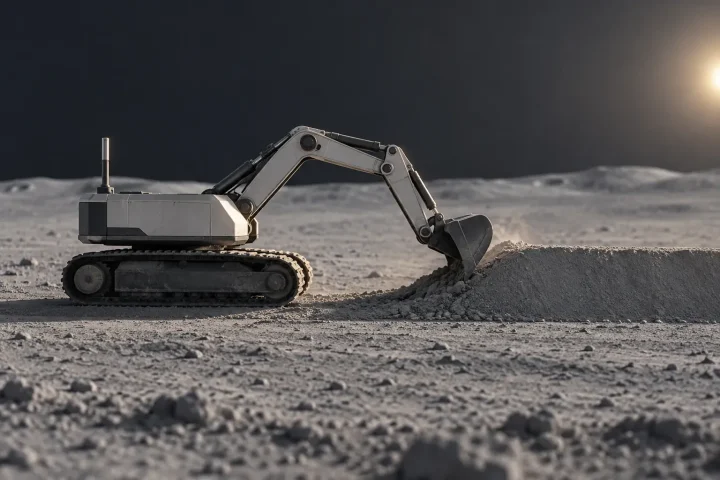
A future Moon base may not begin with a habitat, a flag, or a crew stepping through an airlock. It may begin with a machine moving dirt. According to NASA, long-duration lunar exploration depends on a network of enabling technologies: reliable power, water and oxygen made from local resources, landing pads, roads, communications, thermal protection, and systems that can work through the lunar night. The vision is less like delivering a finished outpost and more like building the first infrastructure of a remote neighborhood, one difficult task at a time.
The unglamorous work of arrival
Lunar regolith is more than scenery. It must be moved, shaped, stabilized, and kept away from sensitive equipment. NASA’s Infrastructure Pilot Excavator, or IPEx, is designed to dig, collect, and transport regolith using lightweight counter-rotating bucket drums. Its role could include preparing landing areas, building berms, and shaping construction sites while taking advantage of the Moon’s reduced gravity.
Dust creates another barrier. NASA’s Electrodynamic Dust Shield uses electric fields to lift and remove abrasive regolith from surfaces. The technology demonstrated dust removal during Firefly Aerospace’s Blue Ghost Mission 1 in 2025, showing how a relatively narrow engineering problem can determine whether cameras, solar panels, suits, and instruments remain useful.
Power that survives the night
The lunar day and night each last nearly 15 Earth days, producing extreme thermal conditions and long periods without sunlight. NASA is advancing vertical solar arrays that can deploy on uneven ground, regenerative fuel cells that store energy chemically, and other power systems for polar regions and permanently shadowed areas. The goal is continuity: equipment should not have to shut down simply because the Sun has moved below the horizon.
That same systems perspective appears in NASA’s work on thermal materials, radioisotope power, communications, and autonomous navigation. Small rovers in the CADRE project are intended to cooperate while mapping and surveying, while other systems explore how artificial intelligence and machine learning might help machines determine their positions and navigate difficult terrain with less reliance on human operators.
Using what the Moon provides
A sustained presence also depends on reducing what must be launched from Earth. NASA’s in-situ resource utilization projects investigate ways to process lunar materials, including extracting oxygen from regolith. Other technologies study how local materials might support power generation, manufacturing, or construction. These efforts remain technology development, not a completed lunar economy, but they point toward a different model of exploration: missions that gradually acquire more capability from their surroundings.
The editorial lesson is straightforward. Frontier ambitions are often carried by infrastructure that attracts little attention: excavation, energy storage, dust control, navigation, and thermal design. The first builders of a lunar settlement may be machines that never need a habitat. Their progress will be measured not by spectacle, but by whether the next machine can land, survive, find its way, and make the ground more useful for whoever follows.
AI-generated editorial illustration; not a documentary photograph.
Source: Lunar Surface Technology
 SIGNAL TITANS
Leave a Reply